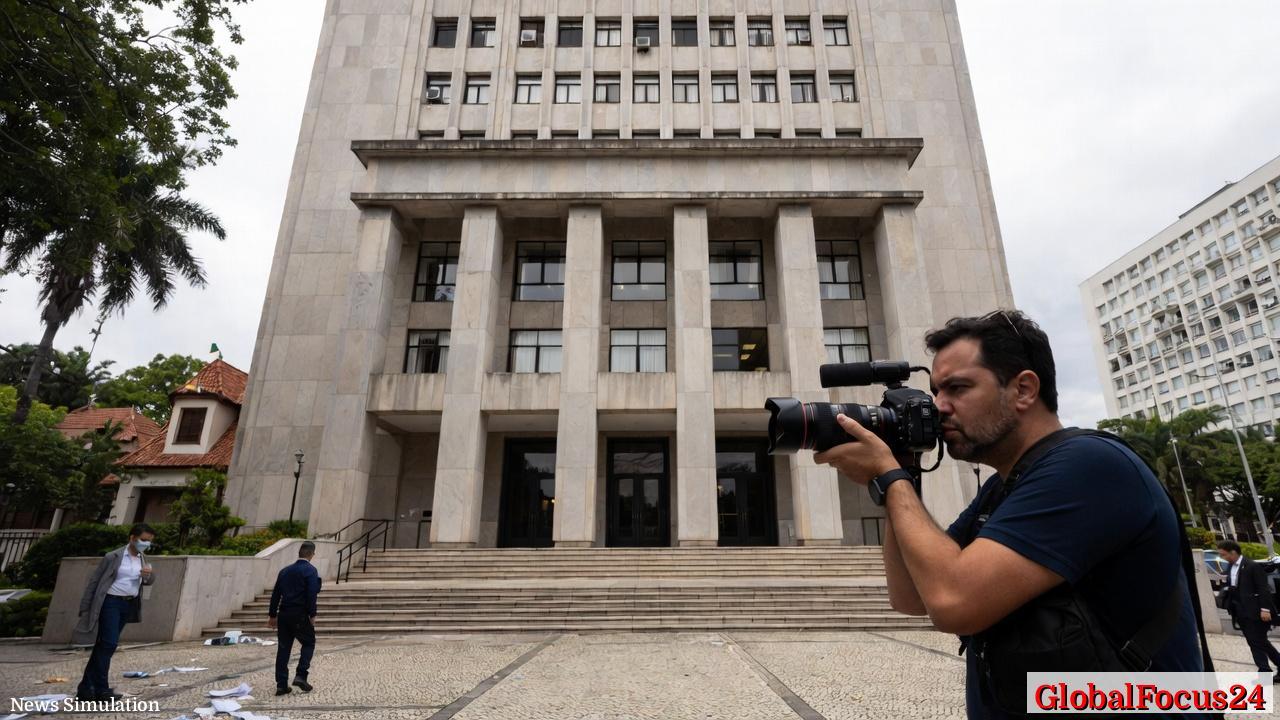
Brazilians face a banking collapse that exposes a wider web of influence and accountability
The collapse of Banco Master, a mid-sized Brazilian lender, has set off a financial and political aftershock across Brazil’s economy. As the deposit guarantee fund moves to reimburse savers at unprecedented scale, the case has raised questions about the relationships between finance, politics, and the judiciary in a country accustomed to vibrant, sometimes turbulent, markets—and to the entanglement of power with corporate interests. This is not merely a bank failure story. It is a lens into how corporate leverage, institutional ties, and rapid transformation in a high-stakes financial system can ripple through regions, sectors, and governance structures.
A rapid ascent and a dramatic fall
Banco Master’s trajectory began with an ambitious strategy under Daniel Vorcaro, who seized control of the institution in 2019. The strategy leaned on aggressive growth, a hallmark of several resilient mid-tier banks in emerging markets that seek scale quickly to compete with larger national lenders. The bank offered unusually high interest rates on fixed-income certificates, a product that attracted savers seeking solid yields in a low-interest-rate environment. This approach allowed Banco Master to capture market share in a short window, expanding deposits and funding its lending book with relatively attractive terms.
By 2023 and into 2024, the bank’s balance sheet appeared robust to many observers who follow mid-sized banks that ride the inflation-adjusted yields tailwind and the appetite of retail investors for fixed-income securities. However, the veneer of rapid success masked underlying fragilities. In September, the cracks became visible when Vorcaro attempted a sudden sale—an act that would test liquidity, counterparty risk, and investor confidence. The proposed deal with Banco de Brasília (BRB), a bank controlled by the Federal District government, collided with painful realities: the Central Bank identified liquidity problems and questioned the quality of loan portfolios that Banco Master had used to back the sale.
The fallout intensified when authorities disclosed that Banco Master had transferred or sold credits worth more than $2 billion, assets that carried significant risk and, in the view of regulators, degraded the bank’s solvency. As scrutiny sharpened, Vorcaro was arrested while attempting to flee the country on a private jet. The arrest underscored a broader theme: in fast-moving financial environments, an individual’s strategy and personal risk posture can quickly collide with regulatory expectations and legal constraints.
The monumental cost to savers
Brazil’s deposit guarantee fund, known as the Fundo Garantidor de Créditos (FGC), is designed to protect small savers during banking distress. In the Banco Master case, the FGC is projected to pay between $7.5 billion and $10 billion to compensate depositors. This prospective payout would mark the largest single intervention in Brazil’s deposit insurance history, signaling both the severity of the event and the state’s willingness to absorb costs to preserve public confidence in the financial system.
The size of the potential payout also raises questions about the system’s resilience and the timing of intervention. When a bank shows signs of structural weakness, the speed and decisiveness of regulatory actions—interventions by the Central Bank, supervisory authorities, and the judiciary—can influence the ultimate cost to taxpayers, the stability of credit markets, and regional economic confidence. In Brazil’s current context, the Banco Master case tests the boundaries of what a domestic resolution framework can absorb without triggering wider financial disruption.
Linkages to Brazil’s elite and governance challenges
Beyond the immediate financial dynamics, the Banco Master affair has drawn attention to long-standing questions about the depth of ties between Brazil’s financial sector and the country’s political and judicial elites. Investigators and observers have detailed a network of relationships that appear to extend across political blocs, agencies, and the judiciary, shaping perceptions of fairness and independence in crisis moments.
Even as the Central Bank moved to liquidate the institution in November, questions emerged about the speed and rationale of the decision. A high-profile inquiry was initiated by a judge within Brazil’s TCU, or Court of Accounts, whose actions signal a willingness to scrutinize the process itself. The judge’s inquiry into alternative options and the speed of resolution reflected an unusual intervention in the Central Bank’s traditional authority, highlighting how checks and balances—intended to safeguard public funds—are tested in moments of systemic risk.
On the political front, members of the Centrão, a centrist voting bloc noted for its influence and, at times, corruption allegations, reportedly sought to shield the bank from closer scrutiny. One senator pressed to block a congressional inquiry and called for the removal of the Central Bank president by legislative action. In parallel, Brasília’s political leadership publicly supported the BRB acquisition, signaling how regional dynamics—capital federal governance and local political interests—can intersect with financial consolidation strategies, particularly when a distressed institution appears to offer strategic advantages to powerful actors.
The web of professional and personal ties
In parallel with official actions, Banco Master’s private dealings drew scrutiny. Investigators found a web of elite-labeled connections in Vorcaro’s communications, including a sizable contract with a law firm led by the wife of a Supreme Court justice. The deal—valued at $24 million and spanning three years—raised eyebrows about transparency and the selection process for legal representation in high-stakes matters. The contract’s vagueness and price point prompted concern among legal experts who monitor the intersection of business interests and judicial processes within Brazil’s highest spheres.
Public confidence hinges on the credibility of the judiciary and the perception that cases are resolved on the basis of law, not influence. Reports later surfaced that the Supreme Court Justice involved, Alexandre de Moraes, had contact with Central Bank leadership ahead of related decisions. Moraes and his wife rejected allegations of improper influence, stating the discussions did not pertain to the bank’s case. Nevertheless, the episode contributed to a broader debate about perceived bias in Brazil’s top court and the broader governance environment.
Maintaining the integrity of oversight
The broader institutional response includes questions about the Central Bank’s autonomy and willingness to prioritize technical considerations over political pressure. The bank’s governor, Gabriel Galípolo, faced pressure during the crisis, with some actors urging rescue measures to avert broader systemic spillovers. Galípolo’s public stance—resisting pressure to rescue the bank and subsequently seeking greater administrative and budgetary autonomy for the Central Bank—reflects a broader push within Brazil to strengthen financial supervision and reduce external interference. The ensuing withdrawal of the inquiry by the Court of Accounts signals a balancing act between transparency and the need to prevent protracted legal entanglements from destabilizing an already fragile resolution.
Regional and historical context
Brazil’s banking sector has a long and varied history of consolidation, competition, and regulatory evolution. Mid-sized banks have often absorbed smaller lenders, creating champions whose growth is fueled by retail deposits, fixed-income products, and a mix of traditional lending and merchant services. The Banco Master case stands in a lineage of episodic crises where rapid growth, aggressive asset allocation, and political entanglements converge. In regional terms, the exposure of a major urban center bank—with significant deposits from tens of thousands of households and small businesses—has echoes in other economies where mid-sized banks face pressures from rapid market changes, capital adequacy concerns, and governance scrutiny.
A comparative lens helps illuminate what Brazil is experiencing now. In several Latin American markets, periods of bank distress have followed exuberant growth phases and opaque credit portfolios. While each country has its own regulatory framework, the underlying tensions—difficulty in ensuring liquidity during a shock, ensuring robust risk management for non-core assets, and maintaining public confidence in the deposit protection framework—are common themes. The Brazilian response, including the large FGC payout, reflects a systemic approach to risk containment, signaling to savers and lenders alike that the state remains committed to financial stability even in the face of a costly failure.
Impact on regional economies and sectors
The Banco Master shutdown is not only a financial event; it reverberates through regional economies and sectors reliant on micro- and small-business lending, consumer finance, and household savings. Banks of this size play a pivotal role in funding regional commerce, mortgages, and personal loans where larger institutions may be perceived as less nimble. In the immediate term, the acceleration of deposit withdrawals and tighter liquidity conditions could prompt a risk-averse lending environment, with lenders recalibrating loan pricing, collateral requirements, and credit appetite. Small businesses—often the backbone of regional growth—could face higher borrowing costs or tighter credit conditions, with knock-on effects on employment and investment in communities that rely on local banks for financing.
The social dimension is equally important. Large-scale deposit protections can provide reassurance to savers who may be risk-averse after observing a high-profile collapse. Yet, the public discourse around the ties between political power and financial decision-making can influence trust in institutions. The narrative surrounding ethics, independence, and accountability matters for how citizens perceive the integrity of both the banking system and the judiciary.
What the future holds for Brazil’s financial system
Brazil’s authorities are likely to continue strengthening supervision, risk controls, and accountability frameworks to prevent a repetition of the Banco Master scenario. A pivot toward greater clarity around the governance of banks, tighter criteria for asset quality, and more transparent contracting with external legal and consulting firms could help rebuild confidence in financial institutions and market regulators. The Central Bank’s push for greater autonomy is consistent with a broader international trend: central banks seeking more insulation from political cycles to sustain credibility and effectiveness in crisis management.
Regional comparisons underscore the importance of robust, well-functioning oversight mechanisms. In markets with similar growth trajectories—where banks expand rapidly to meet rising demand while managing complex asset portfolios—the balance between fostering competition and ensuring prudence remains delicate. Brazil’s challenge is to reconcile rapid digitalization and consumer finance expansion with rigorous scrutiny of risk exposures and governance integrity.
Public reaction and accountability
Public sentiment surrounding the Banco Master affair is mixed. Some observers argue that the collapse reveals the fragility of a system in which political and judicial elites maintain close, sometimes opaque connections with major economic actors. Others contend that Brazil’s institutions are responding with appropriate urgency, using the FGC as a backstop to protect savers and deploying regulatory tools to stabilize the banking sector. The challenge for policymakers is to preserve public confidence while ensuring accountability for decisions that affect millions of citizens, from ordinary savers to institutional investors.
In the months ahead, observers will watch how the Central Bank clarifies its decision-making framework, how the judiciary handles related investigations, and how political actors respond to calls for greater transparency. The outcome of these dynamics will influence Brazil’s broader reputation as a destination for investment, its capacity to sustain growth, and its ability to maintain the integrity of its financial institutions in the face of high-profile crises.
A note on ethical considerations and responsible journalism
From a reporting perspective, it is essential to present complex information clearly, without sensationalism, while avoiding speculation not supported by verifiable evidence. The Banco Master case embodies a difficult intersection of finance, governance, and public trust. Providing a careful chronology, clear attribution of facts, and context helps readers understand the nuances involved. It is equally important to distinguish between confirmed facts and ongoing investigations, to respect due process, and to avoid drawing conclusions not yet substantiated by evidence.
Concluding observations
The Banco Master episode is a watershed moment for Brazil’s financial system and governance landscape. It underscores how swiftly a mid-sized bank can evolve into a crisis test for liquidity, regulatory oversight, and public trust. The size of the FGC payout signals the seriousness of the event and the country’s commitment to protecting savers. It also shines a spotlight on the complex relationships that can develop at the intersection of finance, politics, and the judiciary, prompting a broader conversation about transparency, accountability, and institutional integrity in Brazil.
As Brazil navigates the aftermath, the path forward will rely on strengthening risk management, ensuring the independence and efficacy of regulatory bodies, and fostering a public understanding that the stability of the financial system is a shared responsibility among policymakers, banks, and citizens. The coming years will reveal whether reforms can fortify Brazil’s banking framework against future shocks while maintaining the open, competitive, and innovative financial environment that serves households and businesses across the country.