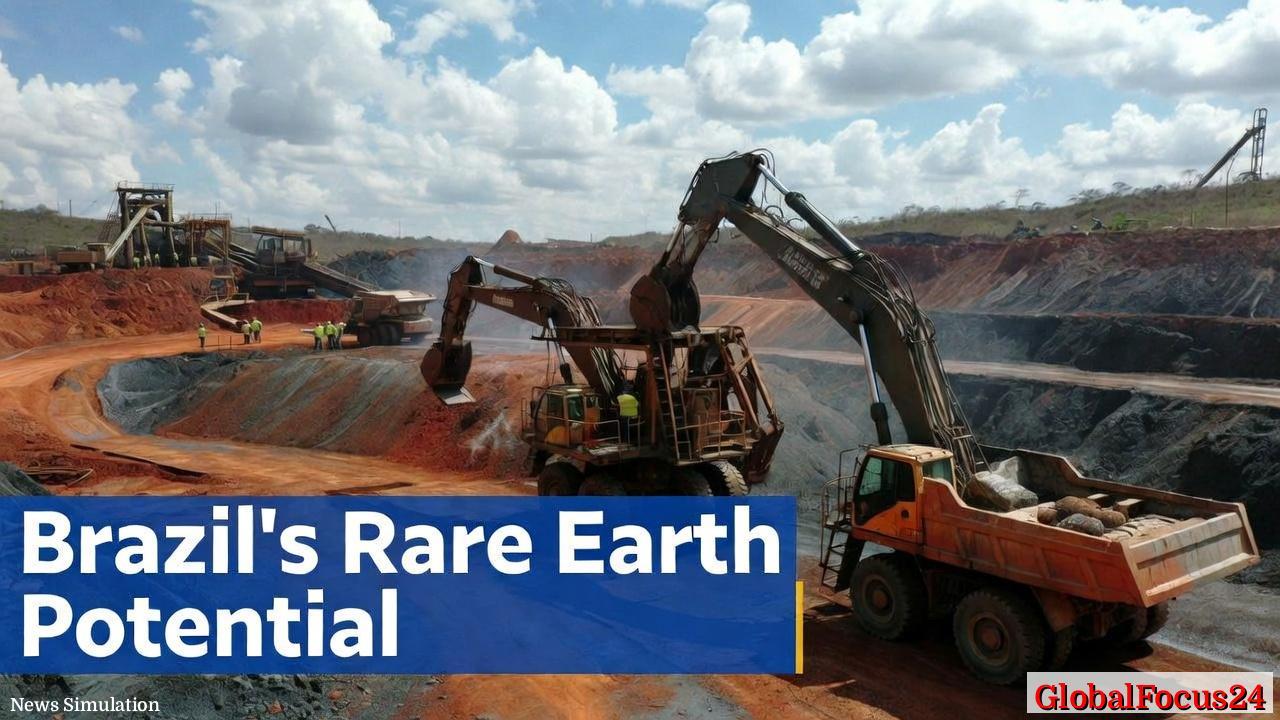
Brazil Eyes a New Frontier in Rare Earths: Strategic Moves to Diversify Global Supply
Brazil is positioning itself as a rising player in the global rare earths landscape, leveraging its geology, established mining infrastructure, and a national policy push to broaden the supply chain for these critical minerals. With 17 elements essential to high-tech manufacturing—from missiles and magnets to microwaves and green-energy components—rare earths are proving to be as strategically significant as they are economically valuable. Brazil’s current trajectory seeks to balance domestic development with international demand, offering an alternative to a market long dominated by China and, to a lesser extent, other producers in Africa and Oceania. The path forward combines new mining projects, processing capacity plans, regulatory reforms, and strategic public-private collaboration, all set against a backdrop of global supply constraints and shifting geopolitical incentives.
Historical context: a long arc toward strategic minerals Rare earths arrived on the global stage as a set of critical inputs during the late 20th century, but their importance surged in the 2000s as modern electronics and clean-energy technologies expanded. For decades, China has dominated both mining and processing, a dual leverage that has shaped global pricing, supply resilience, and policy reactions in consumer markets and defense industries alike. Brazil’s geological endowment—comprising tailings-friendly ore bodies and favorable hydrological basins—complements a history of mining excellence that stretches back to iron ore and other mineral exports. While Brazil’s mining sector has long been a pillar of its economy, the shift toward rare earths marks a strategic diversification: a move from commodity export volumes to value-added production, with an emphasis on secure, localized supply chains for critical technologies.
Economic impact: potential, constraints, and regional ripple effects Global demand for rare earths continues to grow as high-tech manufacturing scales up—everything from advanced magnets used in electric vehicles and wind turbines to precision electronics and defense systems relies on these elements. Brazil’s emergence as a non-Chinese supplier could recalibrate regional and global supply dynamics. In the near term, a single operating mine and the development of separation and processing facilities signal the start of a longer industrial journey. The economics are nuanced: while initial projects can unlock new revenue streams and employment, the real economic lift depends on successful capital formation, efficient mineral processing, and the ability to move from ore to refined products at competitive costs.
- Mining and production: Brazil has opened a notable mine in 2024 and plans to scale heavy rare earths from non-Chinese sources. The expected growth of supply hinges on the construction of separation plants and downstream facilities. The timeline suggests that most new production will come online by 2028, a multi-year horizon that requires sustained investment and policy support.
- Processing and value-add: A central challenge is developing domestic processing capabilities. Processing rare earths is capital- and technology-intensive, requiring specialized knowledge to separate and purify mixed oxides into market-ready products. Brazil’s strategy emphasizes domestic value capture, but policy and regulatory navigation, along with high upfront costs, will shape how quickly beneficiation occurs locally versus exporting concentrates for overseas refinement.
- Regional comparisons: Brazil’s approach contrasts with regions that already host mature processing ecosystems, such as parts of Asia and Europe, where integrated mining-to-magnet production chains exist. In Latin America, Brazil’s initiative may inspire neighboring countries to reevaluate their own endowments and regulatory environments, potentially creating a regional network of mining hubs, technology partners, and shared infrastructure.
Policy framework and government role: unlocking financing and procurement advantages The Brazilian government has elevated rare earths to the status of a national-security matter, unlocking a package of advantages designed to accelerate development. These include targeted financing, public procurement preferences, and streamlined import processes. The rationale is straightforward: reduce bottlenecks that have historically slowed project timelines and help domestic firms compete with international players who command scale and expertise.
Key policy levers include:
- National strategy alignment: A coherent strategy ties exploration, mining, processing, and end-use markets into a shared national objective, reducing policy fragmentation and enabling cross-agency coordination.
- Financing and procurement: Access to preferential financing supports capital-intensive mining and processing ventures, while procurement preferences help domestic firms win contracts for public sector projects and strategic infrastructure.
- Import efficiency: Simplified import regimes for critical machinery, components, and expertise reduces lead times and lowers the effective cost of bringing in specialized equipment or technical know-how.
- Innovation incentives: Measures to boost research and development help Brazil climb the value chain—from raw ore toward refined products and magnet-grade materials.
Public reaction and market sentiment: confidence, caution, and opportunity Industry stakeholders and regional analysts view Brazil’s push as a potential turning point for diversification in the global rare earth market. Confidence is tempered by typical sector challenges: licensing delays, the need for specialized processing facilities, and the imperative to retain value domestically rather than exporting raw ore. Investors are weighing regulatory timelines against the upside of being an early mover in a market with growing strategic significance. International buyers—most notably the United States, the European Union, Japan, and South Korea—are watching closely, given their interest in broadening sources of supply and reducing exposure to single-country risk.
The United States has signaled interest in future Brazilian output as part of broader conversations linking critical-mineral supplies to trade policy and national security. European partners and Asian buyers may follow, spurred by a desire to diversify portfolios, strengthen supply resilience, and look for regional allies with shared standards on environmental stewardship and ethical mining practices. Public opinion in Brazil recognizes both the promise of job creation and the need to balance environmental impact, community engagement, and sustainable mining practices—an ongoing discussion that accompanies any large-scale resource development.
Geopolitical context: supply resilience and strategic considerations The evolving landscape of global mineral security underscores why Brazil’s rare earth ambitions matter beyond the metals themselves. Rare earth dependencies create exposures for defense and high-tech manufacturing, prompting governments to pursue diversified supply chains that can withstand export controls or tariff pressures. In this context, Brazil’s geological advantages and political will to support domestic capacity sit at an intersection of economic development and strategic autonomy.
- China’s dominance remains a reference point for market dynamics. While export controls have historically shaped the price and availability of rare earths, the current environment emphasizes resilience through diversification and regional partnerships.
- North American and European incentives align with similar objectives: reduce strategic risk, secure access to critical inputs, and encourage domestic innovation ecosystems that can compete on a global stage.
Operational challenges and pathways to scale While the outlook is optimistic, practical obstacles must be addressed to translate potential into steady production and sustained economic impact.
- Regulatory timelines: Delays in licensing can slow project progression, affecting finance plans, construction schedules, and production ramp-ups. A predictable licensing framework will be essential for investor confidence.
- Processing costs: Domestic separation and refining facilities require significant capital and technical expertise. Partnerships with international institutions or technology transfers may accelerate capability development.
- Skill development: The industry demands specialized engineering, mining, and metallurgy talent. Brazil will need targeted education and training programs to build a workforce capable of supporting full-scale operations.
- Export policy and value retention: The policy emphasis on retaining value locally will influence how much concentrate Brazil exports versus how much it refines domestically. A balanced approach could maximize local employment and technological spillovers while maintaining attractive export revenues.
Future prospects: a multi-decade trajectory with global implications Brazil’s rare earth initiative is not a sprint; it is a marathon with potential to reshape regional supply chains and influence global pricing dynamics. Early-stage projects demonstrate feasibility, but the long-term payoff will depend on the successful development of processing capacity, sustained policy support, and the ability to establish reliable logistics and trade partners. If Brazil can scale up to a diversified supply base—covering multiple rare earths and producing refined materials suitable for magnet production and other high-tech applications—the country could become a meaningful node in a more resilient international supply network.
Conclusion: positioning Brazil as a strategic supplier in a dynamic market Brazil’s rare earth strategy reflects a broader shift toward strategic mineral independence and innovation-led growth. By leveraging favorable geology, an established mining ecosystem, and a government-ready framework for financing and procurement, Brazil is pursuing a measured yet ambitious path to join a select group of nations shaping the future of critical minerals. The road ahead will require continued political will, prudent investment, and steady collaboration between government, industry, and academia. If realized, the initiative could contribute to more diversified global supply chains, enhance regional economic development, and strengthen the capacity of high-tech industries to innovate without being beholden to a single dominant supplier.