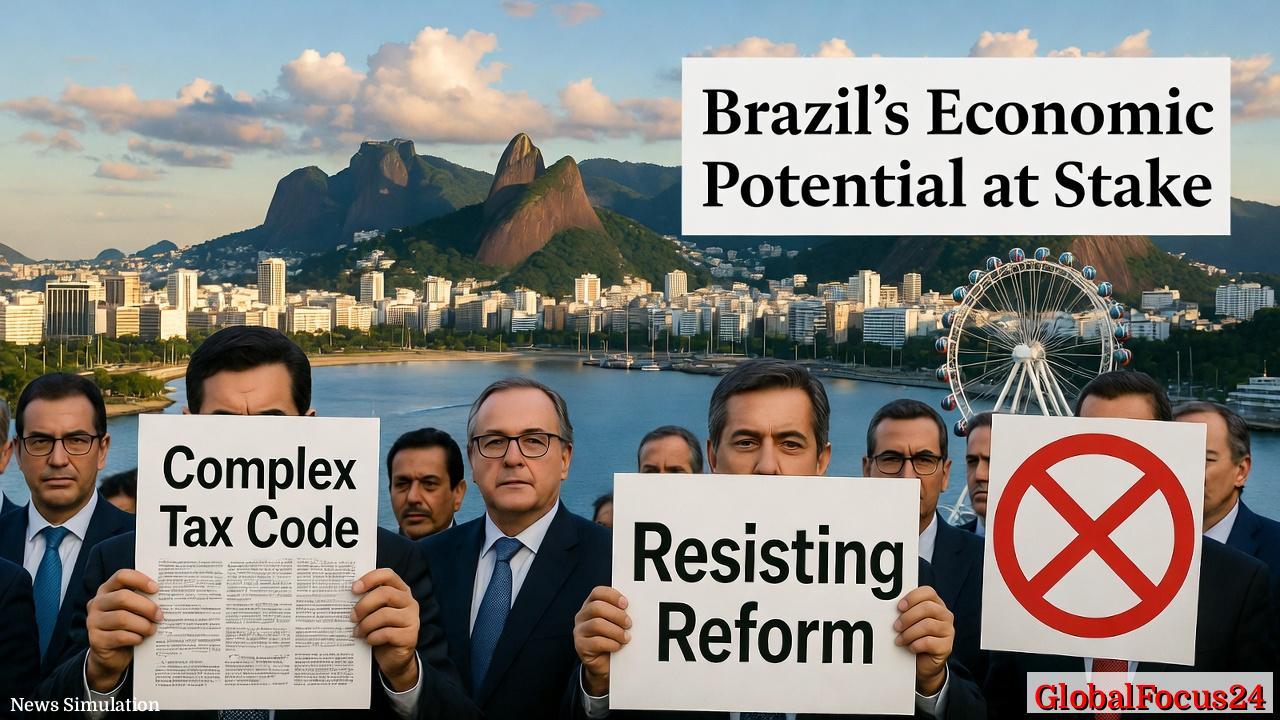
Entrenched Interests Are Throttling Brazil's Economy
From Rio de Janeiro, Brazil—Brazil stands at a pivotal moment. With macroeconomic indicators showing resilience and momentum, the country remains at risk of stalling due to structural headwinds tied to entrenched interests. As the October election approaches, the question is whether policymakers will translate solid short-term performance into durable, long-run growth by tackling barriers that have long constrained productivity, investment, and innovation.
A snapshot of the moment: momentum amid macro stability In recent years, Brazil has posted resilient growth, inflation that has trended downward toward more manageable levels, and unemployment at historically low levels. Average annual growth near 3% over a three-year horizon signals a broader recovery trajectory from cycles of volatility. Inflation around 4.3% sits within a comfortable range by historical standards, supporting real incomes and consumer confidence. These figures, however, mask deeper frictions that could derail the country’s longer-term progress if not addressed.
Historical context: cycles of reform, resistance, and resilience Brazil’s development path over the past few decades has repeatedly paired ambitious reform agendas with persistent political and social pushback. The country built one of the world’s largest consumer markets and a diversified economy that spans agriculture, mining, manufacturing, and services. Yet rapid expansion has often collided with structural constraints: a complex tax system, rigid labor regulations, expansive public spending commitments, and a judiciary system that can generate high compliance costs for business. Each of these elements has, in its own way, shaped incentives for investment and productivity.
The tax labyrinth and investment risk Brazil’s tax code has long been described as a feature-rich obstacle course for businesses. Federal, state, and local levies, with overlaps and exemptions, create a compliance burden that inflates operating costs and dims the appeal of formal investment. Firms frequently cite the difficulty and cost of navigating taxes as a reason to delay expansion plans or shift activities to more accommodating environments. Reform efforts—often framed as essential to improving competitiveness and revenue stability—have repeatedly stalled as sectors with baked-in advantages defend the status quo. In practical terms, the tax maze undermines predictability, complicates capital budgeting, and chills foreign direct investment at a moment when Brazil seeks to attract capital for infrastructure, technology adoption, and export-oriented growth.
Labor market rigidity and productivity Labor regulations in Brazil reflect a tension between worker protections and market dynamism. While strong employment protections provide social stability for current workers, they can reduce labor mobility, raise adjustment costs for businesses, and constrain hiring when demand shifts or new technologies emerge. Companies report that high dismissal and compliance costs, coupled with legal uncertainties, discourage experimentation with new business models or scaling to meet growing demand. Flexible and well-targeted labor reforms could bolster job creation, raise average productivity, and better align wages with output—an essential ingredient for sustained growth in a diversified economy.
Public finances and the allocation of resources Public spending represents a sizable share of Brazil’s fiscal footprint, with pensions and civil-service privileges absorbing a substantial portion of the budget. When a large share of resources is committed to entitlement programs and long-standing official benefits, the room for investment in infrastructure, education, health, and innovation narrows. Reform discussions—such as adjusting retirement ages, recalibrating pension benefits, and reforming civil-service compensation—have faced intense political resistance from groups with vested interests. Without credible consolidation of primary deficits or more efficient spending, opportunities to modernize public services and improve competitiveness are limited.
Judicial and regulatory costs The judiciary in Brazil plays a critical role in upholding rights and enforcing contracts. Yet, elevated compensation, generous perks, and lengthy litigation can raise the cost of doing business and deter swift dispute resolution. Efforts to align public sector compensation with broader fiscal norms encounter opposition from stakeholders who gain from the current arrangements. The net effect is a slower-moving rule of law in some sectors, which can dampen investment signals and raise the perceived risk of capital-intensive projects.
Corruption, governance, and market distortions Corruption cases and governance challenges have underscored how opaque decision-making and favoritism can distort markets. When connected actors benefit from subsidies, protective measures, or regulatory advantages, the playing field tilts away from competitive, efficiency-driven investment. The public’s trust in institutions can erode in tandem with market confidence when graft appears to influence outcomes. Reducing these distortions requires transparent procurement, stronger anti-corruption enforcement, and clearer rules for regulatory capture—an agenda that policymakers, business leaders, and civil society can rally behind if framed around competitiveness and fairness.
Economic impact of reform versus reform delay Analysts estimate that removing or reforming major impediments could lift trend growth toward 5% or higher. A more streamlined tax regime would reduce compliance costs and improve investment predictability. Flexible, performance-based labor reforms could spur job creation and productivity gains, particularly in sectors where modern technologies and data-driven processes unlock new efficiencies. Prudent spending reforms—curbing unsustainable pension growth and reorienting public investment toward infrastructure, education, and health—could free resources for high-return projects that support long-run competitiveness. Enhanced governance and anti-corruption measures would lower the implicit cost of doing business and reassure both domestic and international investors.
Regional comparisons and lessons Brazil sits among emerging-market peers that have pursued structural reforms to unlock growth. In Latin America, countries that implemented credible tax modernization, labor market flexibility, and pension reform alongside prudent fiscal stewardship typically attracted more stable investment and higher trend growth. Comparisons with regional economies highlight the potential gains for Brazil if reforms are implemented with credibility and social legitimacy. While some neighbors have faced political resistance to comprehensive changes, others have shown that well-communicated reform packages paired with social protection measures can maintain growth while expanding opportunity.
Public reaction and the politics of reform As voters weigh outcomes in October, public sentiment about reform varies by demographic and regional context. Business communities often express urgency for regulatory clarity, predictable tax regimes, and investment-friendly labor rules. Workers and civil-service groups frequently emphasize the importance of preserving earned benefits and safeguards. The challenge for policymakers is to craft reforms that are economically essential while delivering credible, widely understood social protections. Achieving this balance requires transparent communication, phased implementation, and inclusive policy design that broadens the gains from growth to a wider share of the population.
Strategic priorities for sustainable growth
- Simplify and modernize the tax system to reduce compliance costs, improve revenue stability, and attract investment.
- Introduce flexible, objective labor-market rules that maintain protections while enabling firms to scale and innovate.
- Recalibrate pension and civil-service benefits to maintain essential social protections while reducing long-term fiscal risk.
- Strengthen fiduciary norms and governance in public institutions to curb waste and corruption, ensuring resources reach tangible public outcomes.
- Expand infrastructure investment, especially in transportation, logistics, energy, and digital connectivity, to reduce logistics costs and enable productivity gains.
- Promote private-sector-led innovation, including support for startups, research and development, and the adoption of advanced technologies in traditional sectors.
Outlook: Brazil’s potential unlocked or constrained? Brazil possesses abundant natural resources, a large and growing domestic market, and a skilled workforce. The country’s ability to translate these strengths into sustained, high-quality growth hinges on politically viable reforms that address the structural bottlenecks described above. If reform momentum accelerates and is paired with credible fiscal discipline and strategic public investments, Brazil could accelerate beyond its current trajectory—transforming potential into measurable gains for business, workers, and communities across the nation.
Public interest and the road ahead The path forward is not only about numbers on a balance sheet but about the lived experiences of millions who rely on steady employment, fair wages, and reliable public services. A more predictable business climate, coupled with robust social protection and transparent governance, could foster a virtuous cycle: higher investment, more productive firms, and improved competitiveness—ultimately translating into higher living standards and greater national resilience.
Conclusion: turning momentum into durable advantage Brazil’s recent performance underscores a country that can perform well under the right conditions. The question is whether political leadership and the broader society will converge to replace entrenched protections with dynamic policies that unleash growth while preserving essential social commitments. If reform momentum can be sustained, Brazil has the potential not only to maintain its current economic footing but to redefine its growth trajectory for the decades ahead. The country’s vast resources and young, capable workforce offer a compelling case for confidence—provided policymakers rise to the challenge of balancing equity with efficiency and ensuring that gains are broadly shared as the economy adapts to a rapidly changing global landscape.