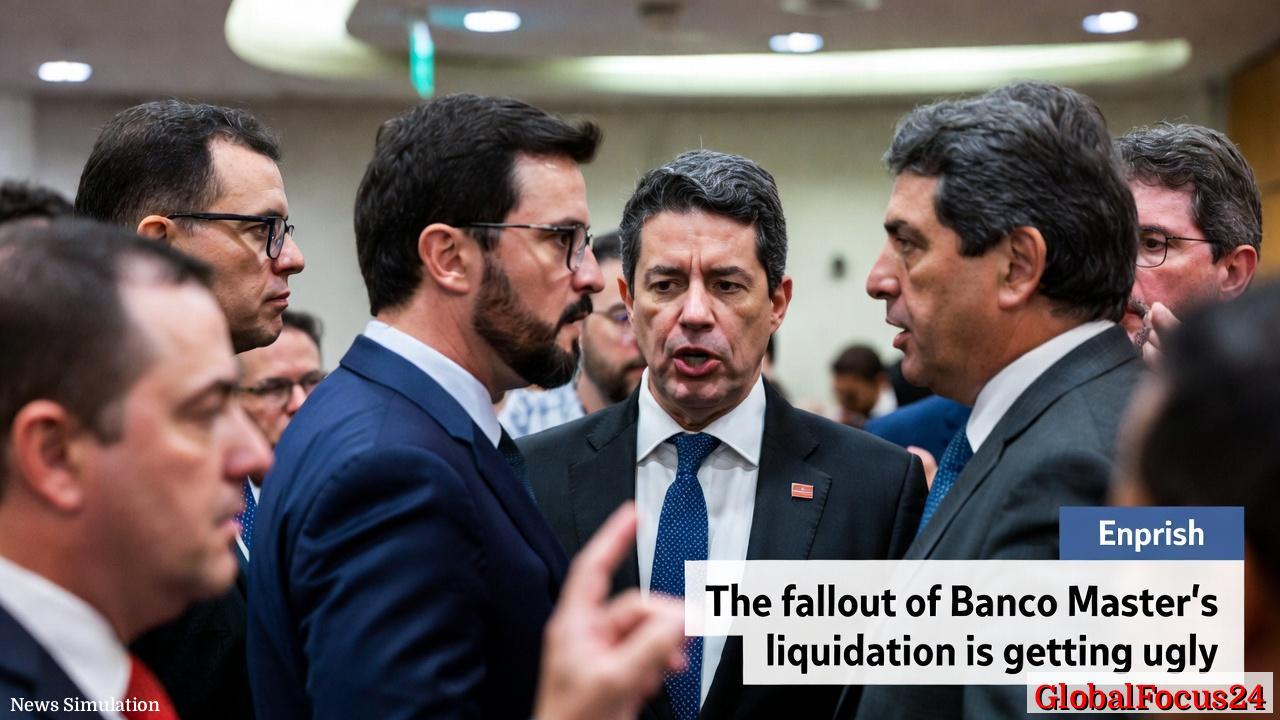
Banco Master Collapse Unfolds: Regional Repercussions, Legal Controversies, and Economic Implications in Brazil
The collapse of Banco Master, Brazil’s once-prominent mid-sized lender, has ignited a complex web of political, judicial, and financial reverberations across the country. As regulators move to stabilize the banking system and mitigate broader contagion risks, the liquidation’s fallout is reshaping public perception of risk, governance, and oversight. The episode offers a stark case study in how a bank failure can expose vulnerabilities in regulatory frameworks, investor confidence, and regional economic dynamics that extend beyond metropolitan financial hubs.
Historical Context: A Long Arc of Risk and Reform
Banco Master’s downfall did not occur in a vacuum. Brazil’s banking sector, while robust in its overall depth, has endured episodic stress tests over the past two decades. The nation’s financial system weathered the global financial crisis, a period of rapid credit expansion, and more recent shifts in monetary policy and inflation management. In this history, regulators repeatedly recalibrated supervision mechanisms, stress-testing requirements, and capital adequacy standards to align with international best practices while addressing domestic credit cycles.
Historically, Brazilian banks have relied on a mix of traditional retail deposits and wholesale funding. The reliance on cross-border investment flows, sovereign debt instruments, and a diversified portfolio of loans means that localized shocks can echo through the system. In this context, Banco Master’s liquidation has prompted a renewed examination of risk controls, risk-weighted assets, and the resilience of smaller banks that operate at the edge of scale but with significant local footprints.
Economic Impact: Immediate Costs and Broader Implications
The immediate consequence of the liquidation is a measurable tightening of liquidity for clients, counterparties, and regional businesses that relied on Banco Master for credit and transactional services. Depositors are understandably anxious about access to funds, while borrowers face potential disruptions in ongoing credit facilities, instrument maturities, and refinancing options. The short-term effect includes a slowdown in consumer lending activity in markets where Banco Master maintained a meaningful share of wholesale and commercial lending.
Beyond the balance sheets, the liquidation reverberates through regional economies that depend on small and mid-sized financial institutions for financing, especially in mid-tier cities and peri-urban areas. Local banks often fill gaps left by larger lenders, offering tailored credit solutions to small businesses, agricultural enterprises, and family-owned firms. When a bank fails, the knock-on effects—credit tightening, tighter lending standards, and higher borrowing costs—can slow local investment cycles, affect employment in dependent sectors, and alter the pace of regional development projects.
From a macroeconomic lens, authorities emphasize that the banking system remains sound overall, backed by insurance funds and regulatory safeguards designed to absorb shocks. Still, the public perception of stability is pivotal. Confidence recovery hinges on transparent communication, rapid resolution mechanisms, and demonstrable steps to ensure that similar vulnerabilities do not recur in the near term. The central bank and regulatory agencies have underscored their commitment to preserving a functional payment system, maintaining access to essential financial services, and preserving the integrity of market operations.
Regional Comparisons: Lessons from Brazil’s Diverse Banking Landscape
Brazil’s regional banking landscape features a spectrum from large, diversified institutions with international reach to smaller, community-focused banks that concentrate their activities within state borders or metropolitan regions. The Banco Master episode invites comparisons with other regional cases to illuminate ongoing systemic strengths and fragilities.
- Northeast and Southeast contrasts: Regions with historically higher credit needs and more dynamic small-business ecosystems depend heavily on local banks for working capital. The fallout from Banco Master’s liquidation could disproportionately affect micro- and small-enterprise lending, potentially prompting a shift toward alternative funding channels, such as fintech lenders or cooperative credit unions, in certain markets.
- Rural credit dynamics: In areas with agricultural activity, small banks often finance seasonal cycles, equipment purchases, and operating costs. A liquidity disruption can have immediate consequences during planting or harvest windows, amplifying the urgency for timely liquidity support from national or regional authorities.
- Urban financial ecosystems: Metropolitan hubs tend to have more diversified funding sources and more robust secondary markets for bank liabilities. In these areas, the impact may be buffered by alternative facilities and stronger liquidity buffers, though spillovers to corporate credit markets and interbank funding can still occur.
Policy and Oversight: How Authorities Responded and What Comes Next
In the wake of the Banco Master liquidation, policymakers have prioritized a multi-pronged response aimed at stabilizing the financial system while preserving access to credit. Key actions include:
- Accelerated resolution planning: Regulators are evaluating expedited liquidation protocols, ensuring that depositors and small businesses can access funds quickly while maintaining orderly wind-down processes for larger, more complex exposures.
- Enhanced transparency: Central banks and supervisory bodies have committed to regular updates on liquidation progress, stress-test results, and risk indicators that could signal evolving vulnerabilities. Public dashboards and routine briefings aim to restore confidence and reduce misinformation.
- Strengthened capital and liquidity buffers: In the months ahead, banks of similar risk profiles may face heightened scrutiny regarding capital adequacy, liquidity coverage ratios, and leverage metrics. The goal is to fortify resilience against idiosyncratic shocks and cross-border liquidity strains.
- Consumer protections and deposit guarantees: Authorities emphasize that insured deposit schemes and consumer protections remain intact, with communications focused on clarifying which funds are protected and how withdrawals or transfers will be processed during the wind-down phase.
- Regulatory modernization: The episode has intensified debates about risk governance, governance standards in boardrooms, and the sufficiency of supervisory tools for smaller institutions. Proposals under consideration include more frequent on-site inspections, enhanced data reporting, and improved early-warning indicators to catch strain before it becomes systemic.
Public Reaction: Trust, Urgency, and the Human Dimension
Public sentiment surrounding the Banco Master case is a blend of concern, skepticism, and calls for accountability. Many observers emphasize the importance of maintaining a level playing field in financial oversight and ensuring that the public perceives the justice system as independent and impartial. Voters and community leaders alike stress that financial stability is a collective public good, with cascading effects on jobs, housing, and household budgets.
Media narratives during the unfolding events highlighted a tension between rapid resolution and thorough due diligence. Citizens want clarity on how decisions are made, who bears responsibility for oversights, and what steps are in place to prevent repeats. The human dimension—small business owners negotiating contingency plans, families worried about deposits, and employees facing uncertainty—drives a broad-based demand for transparent, timely communication from authorities and institutions alike.
Banking Technology and Risk Management: A Modern Challenge
In the broader context of financial stability, the Banco Master liquidation underscores the evolving challenges facing banks as they adopt digital platforms, embedded finance, and increasingly complex asset-liability structures. The integration of fintech partnerships, online lending marketplaces, and non-traditional funding sources adds speed and flexibility but can also introduce new risk vectors. Strengthened cybersecurity, data governance, and third-party risk management are essential components of modern risk management that regulators and institutions are prioritizing.
Moreover, the shift toward more data-driven risk assessment tools—encompassing credit scoring, real-time liquidity monitoring, and scenario analysis—reflects a broader industry trend. Banks that invest in robust risk analytics, diversified funding sources, and resilient contingency plans are better positioned to navigate turbulent periods, protect depositor confidence, and maintain lending continuity during stress episodes.
Comparative International Context: What Analysts Observe
Analysts often compare Brazil’s experience with similar episodes in other emerging markets to gauge the universality of lessons learned. In several peer economies, rapid shock events in mid-sized banks have prompted reviews of deposit guarantee schemes, resolution frameworks, and supervisory capacity. Common themes across regions include the importance of timely disclosures, the value of credible, independent investigations into the causes of failure, and the necessity of maintaining uninterrupted access to essential payment services.
These international comparisons highlight that while the specifics of each case differ, the core principles of financial stability—transparent governance, robust risk management, and proactive supervision—remain constant. The Banco Master episode may thus influence regulatory dialogue and policy design not only within Brazil but also among regional partners evaluating similar risk profiles and market structures.
Future Outlook: Paths Toward Stability and Growth
Looking ahead, the path to stability involves a combination of policy discipline, market discipline, and continued public engagement. Authorities are expected to finalize liquidations in a way that minimizes disruption to ordinary citizens and keeps credit flowing to productive sectors. The financial sector’s focus will likely center on reinforcing capital adequacy, improving liquidity resilience, and enhancing transparency around risk exposures.
For regions most affected by Banco Master’s liquidation, recovery will hinge on the speed and efficiency of credit market adjustments, the depth of regional funding alternatives, and the effectiveness of public-private collaboration to support small and medium-sized enterprises. Investors will monitor the timeline of resolution activities, assessing how quickly confidence returns and whether the broader banking ecosystem can absorb the shock without triggering a broader credit tightening cycle.
Public confidence, in particular, will depend on consistent messaging about safety nets, depositor protections, and the proactive identification of risks before they escalate. In an environment where regional economies rely heavily on access to credit for growth, maintaining a steady flow of financing will be essential to prevent downstream effects on employment, price stability, and investment.
Conclusion: Implications for Brazil’s Financial Landscape
The Banco Master liquidation represents a significant episode in Brazil’s financial history, one that tests the resilience of regulatory frameworks, the integrity of judicial processes, and the ability of markets to absorb shocks without cascading disruptions. While authorities emphasize that the system remains sound and that safeguards are in place, the episode also serves as a warning about the vulnerabilities that can surface in mid-sized institutions. The real measure of recovery will be the speed at which liquidity, deposits, and credit access normalize, the degree of transparency that accompanies the resolution process, and the demonstrated commitment to principled governance and independent oversight. As Brazil moves forward, the banking sector’s capacity to balance risk management with growth will be a defining factor in sustaining economic momentum and regional development.