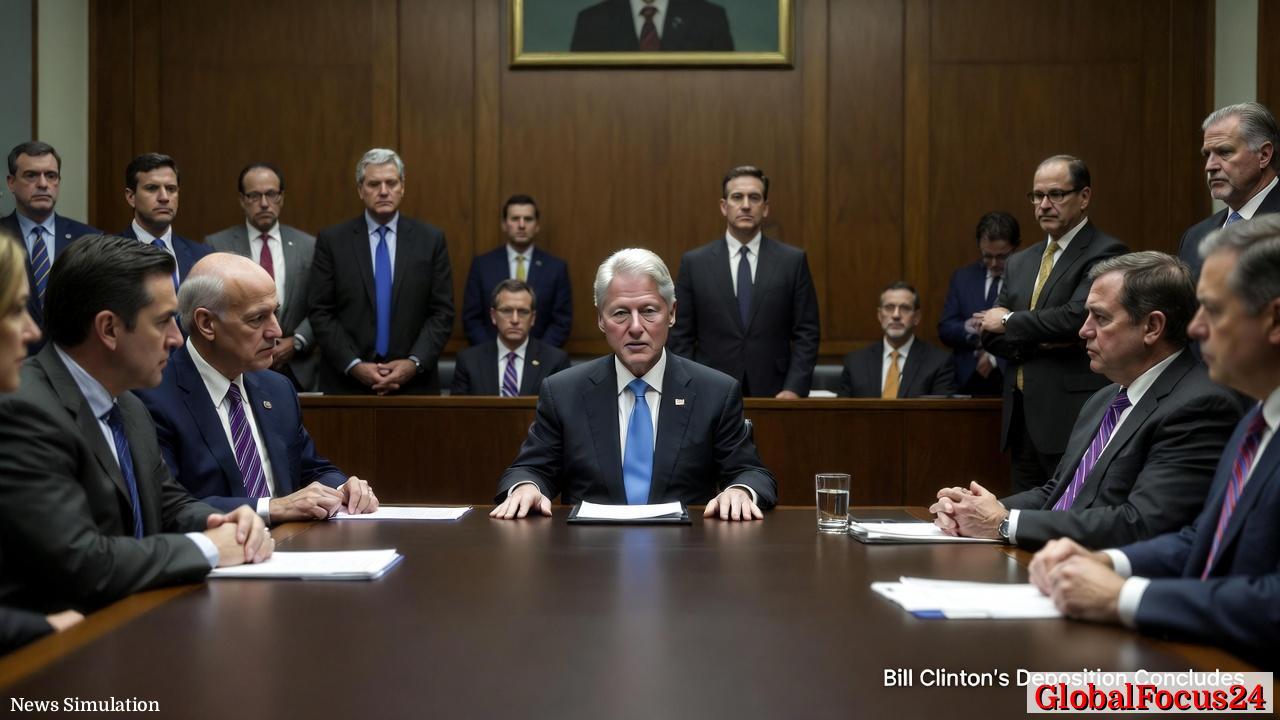
Clinton Completes Six-Hour Deposition Before Lawmakers on Jeffrey Epstein Ties
Former President Questioned in Lengthy Closed-Door Session
Bill Clinton’s deposition before congressional investigators concluded Friday after more than six hours of questioning, with lawmakers saying the former president responded to every inquiry about his past association with Jeffrey Epstein and related matters. The closed-door session, held on Capitol Hill under heightened security and intense media scrutiny, marked one of the most extensive examinations of a former U.S. president by legislators in recent years.
According to participants, Clinton addressed detailed questions about his interactions with Epstein, his travels, and his knowledge of the financier’s criminal conduct, which has continued to fuel public outrage and demands for accountability years after Epstein’s death. Lawmakers from both parties described the deposition as methodical and exhaustive, signaling that Clinton’s testimony will become a central component of the congressional record on the Epstein case and the broader oversight effort into how powerful figures intersected with Epstein’s network.
The deposition forms part of an ongoing series of inquiries aimed at understanding who had contact with Epstein, what they knew, and when they knew it, a process that has drawn in business leaders, political figures, and public officials from the United States and abroad. The Clinton session underscored the enduring sensitivity surrounding Epstein’s legacy and the determination of lawmakers to document the historical record, even as the legal system continues to grapple with related civil cases and unanswered questions.
Historical Context: Epstein Case and Political Institutions
To understand the significance of Clinton’s deposition, it sits within a longer arc of the Epstein saga that has challenged public trust in law enforcement, political institutions, and elite circles. Jeffrey Epstein first faced serious scrutiny in the mid-2000s, when federal and state authorities in Florida investigated allegations of sexual abuse involving underage girls. A controversial 2008 non-prosecution agreement allowed Epstein to avoid a full federal trial, a decision that has since been widely criticized as emblematic of unequal treatment in the justice system.
The case returned to the spotlight in 2019 when Epstein was arrested on federal sex trafficking charges in New York, only to die in jail shortly thereafter. His death, officially ruled a suicide, left victims, investigators, and the public without a full trial that might have clarified many of the relationships and transactions surrounding his activities. In the years since, court releases, civil litigation, and investigative reporting have revealed increasing details about the network of acquaintances, visitors, and associates who moved in Epstein’s orbit.
Former President Clinton’s name has surfaced repeatedly in this context, largely in connection with documented flights on Epstein’s private jet and appearances on travel logs. While Clinton has previously stated that his interactions with Epstein were limited and that he was unaware of any criminal behavior, the absence of sworn testimony to lawmakers had left a gap in the official record. Friday’s deposition appears designed, in part, to close that gap by placing his account under oath in a structured setting that can be referenced in future investigations and historical analysis.
Over time, the Epstein case has come to symbolize broader concerns about the intersection of wealth, power, and accountability. For Congress, revisiting the actions and associations of prominent figures from decades past is not only about individual responsibility; it is also about examining whether the systems tasked with protecting vulnerable people and prosecuting crimes functioned as intended. Clinton’s deposition thus becomes one piece of a larger effort to reconstruct how institutions responded—or failed to respond—to persistent warning signs.
Inside the Deposition: Scope and Tone
People familiar with Friday’s session describe a focused and detailed line of questioning that spanned several key areas. Lawmakers and committee counsel pressed Clinton on:
- The frequency and purpose of his interactions with Jeffrey Epstein, including meetings, events, and communications.
- The nature of his travel on Epstein-linked aircraft or to properties associated with Epstein, including dates, destinations, and accompanying staff or guests.
- Any knowledge he had, at the time or in retrospect, of allegations involving underage victims, recruitment of young women, or financial arrangements linked to Epstein’s activities.
- His understanding of how Epstein’s name came to appear in official and unofficial records related to Clinton Foundation activities, fundraising events, or philanthropic initiatives in which both men were present.
Participants said the former president spoke at length, occasionally consulting documents or notes provided in advance to refresh his memory regarding specific dates and itineraries. Lawmakers indicated that Clinton did not invoke any privilege to avoid questions about Epstein, though discussions touching on classified information, security protocols, or third-party privacy concerns were handled with additional care.
The tone of the session was described as serious and deliberate, reflecting both the gravity of the allegations tied to Epstein and the extraordinary nature of a former president submitting to such prolonged questioning. Members in attendance emphasized that the goal was to create a clear factual record, rather than to generate soundbites or partisan confrontation, aware that the final transcript will likely be scrutinized by legal experts, historians, and the public.
Economic and Institutional Impact of the Epstein Fallout
The fallout from the Epstein case has not been limited to reputations and courtrooms. It has carried measurable economic and institutional consequences across several sectors, from philanthropy and finance to higher education and international business.
In the financial realm, institutions that handled Epstein’s accounts have confronted regulatory reviews, internal investigations, and reputational risk. Banks and wealth management firms associated with Epstein-related transactions have faced questions about their compliance procedures and whether suspicious activity was properly flagged. This scrutiny has contributed to tighter internal controls, enhanced reporting requirements, and, in some cases, settlements or penalties.
Philanthropic organizations and universities that previously accepted donations linked to Epstein or his entities have undertaken reviews and, in certain instances, returned contributions or redirected funds to support victims. This wave of self-examination has influenced how boards evaluate major donors, encouraging more rigorous vetting of benefactors whose backgrounds may carry legal or ethical concerns. The reputational cost of being seen as connected to Epstein has created a ripple effect in fundraising, steering some institutions to adopt more conservative acceptance policies.
For political institutions, the economic impact is intertwined with campaign finance and public trust. Political figures identified in connection with Epstein have faced donor scrutiny, as contributors become more sensitive to perception risks. Legal expenses associated with investigations, document production, and ongoing litigation have also imposed tangible costs on individuals and organizations. Insurance markets, particularly directors-and-officers (D&O) coverage, have been compelled to reassess risk models for entities exposed to high-profile misconduct cases, potentially raising premiums or tightening policy terms.
Viewed through this lens, Clinton’s deposition represents more than an isolated legal event. It sits within a broader realignment in which associations with Epstein can affect not only personal reputations but also the financial health and governance standards of institutions that once sought, or accepted, support from elite donors with limited public scrutiny.
Regional and International Comparisons in High-Profile Abuse Cases
While the Epstein case has become a uniquely American touchstone, it echoes other high-profile abuse scandals that have emerged around the world, revealing common patterns in how legal systems and societies respond when powerful individuals are implicated.
In the United Kingdom, inquiries surrounding figures such as Jimmy Savile and subsequent institutional investigations into abuse within media organizations and public institutions have highlighted similar concerns about deference to celebrity, institutional self-protection, and the reluctance of victims to come forward. In those cases, as with Epstein, posthumous revelations triggered parliamentary inquiries, independent reviews, and reforms in safeguarding practices.
Across continental Europe, several countries have confronted their own scandals involving elite sports, religious institutions, and boarding schools. National commissions and truth-seeking bodies have been tasked with documenting abuses, recommending reforms, and providing avenues for victim compensation. These efforts underscore a common challenge: how to balance due process for the accused with the need to ensure that vulnerable individuals are heard and protected.
In parts of Latin America and Asia, similar cases involving influential business leaders or political figures have prompted a mix of judicial proceedings, media investigations, and, in some instances, street protests. Public reactions often hinge on perceptions of whether the justice system is genuinely independent or susceptible to interference when senior officials or wealthy individuals are involved.
Against this global backdrop, the decision by U.S. lawmakers to call a former president for extended, detailed testimony on his ties to Epstein places the American response within an evolving international trend toward greater transparency and institutional introspection. While each country’s legal framework and political culture differ, there is a growing expectation that high office or economic power should not insulate individuals from serious questioning when systemic abuse is alleged.
Public Reaction and Demand for Transparency
Public interest in the Epstein case remains unusually intense, driven by a combination of unresolved questions, the high profile of those linked to him, and the gravity of the underlying allegations. News of Clinton’s lengthy deposition drew crowds of reporters and onlookers outside the venue, reflecting the extent to which the issue has permeated mainstream discourse and social media debate.
Survivor advocates and legal representatives for victims have repeatedly stressed the importance of a complete and transparent record. For many, the absence of a criminal trial for Epstein himself has left an enduring sense of incompleteness, heightening the significance of depositions, released documents, and court filings that shed light on how his network operated. Clinton’s testimony, while only one piece of that puzzle, is likely to be scrutinized for any discrepancies with previously released information or other witness accounts.
At the same time, there is widespread recognition that the path to full transparency is complex. Privacy considerations for victims, ongoing legal actions, and national security implications tied to high-level travel or communications can limit the immediate release of information. Lawmakers have signaled that they will weigh these factors carefully as they determine how much of Clinton’s deposition can be made public and on what timeline.
For the wider public, the outcome of these decisions will influence perceptions of whether the system is capable of holding powerful individuals accountable, at least to the extent of providing a clear factual narrative. If significant portions of the testimony remain sealed for extended periods, critics are likely to question whether institutional interests are once again taking precedence over full disclosure.
Next Steps in the Congressional Inquiry
With Clinton’s deposition completed, congressional investigators are expected to cross-reference his statements with other testimony, documents, and travel records already in their possession. Staff will examine timelines, review correspondence, and analyze any discrepancies between accounts in an effort to determine whether further questioning of additional witnesses is warranted.
Lawmakers may also consider whether legislative changes are needed to address the gaps revealed by the Epstein case, from how non-prosecution agreements are reviewed to how federal and local authorities coordinate in complex abuse investigations. The experience of other countries, where independent commissions or specialized investigative bodies have been used to tackle institutional abuse, is likely to inform these discussions.
In the near term, attention will focus on whether a redacted transcript or summary of Clinton’s deposition will be released. Transparency advocates argue that making as much information public as possible is essential to restoring confidence in both the justice system and political institutions. Others caution that premature or partial disclosures could complicate ongoing legal matters or misrepresent the full context of the testimony.
For now, the conclusion of the six-hour session underscores how the Epstein case continues to reshape expectations around accountability for past conduct, even at the highest levels of public life. The former president’s answers may not resolve every question, but they mark a notable step in a broader, still-unfolding effort to understand how one man’s crimes intersected with the corridors of power—and how institutions respond when those connections come under the brightest possible spotlight.