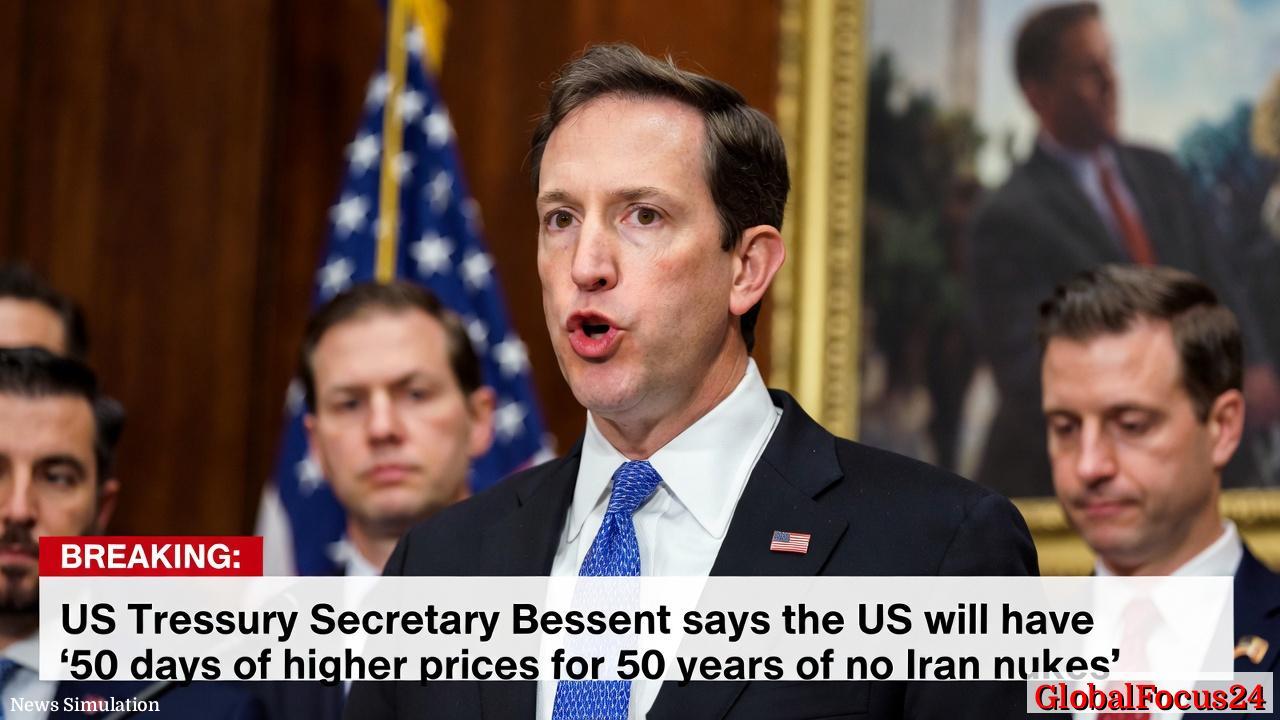
U.S. Treasury Secretary Scott Bessent Says 50 Days of Higher Prices Are the Cost for 50 Years of Security from a Nuclear Iran
America Faces a Period of Price Volatility Amid Rising Tensions with Iran
U.S. Treasury Secretary Scott Bessent stated on Sunday that Americans should prepare for approximately 50 days of “temporary elevated prices,” a short-term economic consequence he said is tied to long-term global security aims. The statement comes as the United States and its allies intensify pressure on Tehran after renewed intelligence warnings over Iran’s nuclear ambitions.
Bessent emphasized that while the current surge in prices will strain households and businesses, the trade-off is intended to prevent Iran from acquiring nuclear capabilities. “Fifty days of temporary elevated prices – prices will come off on the other side – for 50 years of not having an Iranian regime with a nuclear weapon,” he said, underscoring that “there is no prosperity without security.”
The Treasury Secretary’s remarks signal Washington’s expectation of short-lived inflationary turbulence driven by energy supply disruptions, market apprehension, and policy recalibrations targeting Tehran’s nuclear infrastructure and financial networks.
Short-Term Economic Strain and Energy Market Impact
Global oil benchmarks responded almost immediately following Bessent’s comment, reflecting investor concern that extended instability in the Persian Gulf could limit crude exports and tighten supply. Brent crude futures briefly climbed above $97 per barrel on early trading signals out of Asia, while U.S. benchmark West Texas Intermediate (WTI) rose to near $93.
Energy economists describe the expected inflationary window as “acute but temporary,” with the duration depending on both diplomatic developments and logistical adjustments in global shipping lanes. Analysts note that strategic petroleum releases from U.S. reserves could help buffer domestic fuel markets, though such measures take time to cool retail gasoline prices.
For American consumers, the short-term effect is expected to appear most sharply in energy and transportation costs. Gasoline, heating oil, and airfare may all experience noticeable increases, while sectors reliant on petroleum-based inputs—such as agriculture, manufacturing, and logistics—may also see costs rise.
However, Bessent’s framing of the situation seeks to remind the public that these effects, though disruptive, are reversible. He portrayed them as an investment in long-term peace and market stability, asserting that deterring a nuclear-armed Iran is itself a safeguard against future economic chaos.
Historical Context: Economic Ripples from Security Crises
The economic dynamics unfolding now bear resemblance to earlier moments in modern history when geopolitical conflict intersected with energy markets. During the 1973 oil embargo, for example, American consumers endured months of gasoline rationing and substantial price spikes triggered by Middle Eastern geopolitical tensions. Again in 1990, the Gulf War generated a similar, albeit shorter, energy shock that ended once coalition forces restored stability to crude supply flows.
In each case, U.S. policymakers faced a balancing act between immediate consumer pain and longer-term national security objectives. Bessent’s approach follows this historical pattern: openly acknowledging short-term disruptions while asserting confidence in the nation’s economic resilience.
Comparatively, the current U.S. economy enters this period in a stronger position. Inflationary pressures that dominateds in 2022 and 2023 have largely subsided, while unemployment remains low and consumer spending has shown surprising durability. This macroeconomic backdrop may give policymakers more room to absorb temporary cost increases without pushing the country toward recession.
The Global Energy Equation and Strategic Leverage
The U.S. policy calculus toward Iran extends beyond military and diplomatic considerations. It directly intersects with energy security and the delicate equilibrium of global oil production.
Iran, despite sanctions, remains a notable crude producer. When disruptions or heightened tensions limit its exports, markets tend to price in a “geopolitical premium.” For decades, this premium has reflected investors’ fear that Middle Eastern instability could spill into broader supply routes, particularly through the Strait of Hormuz, where nearly one-fifth of all globally traded oil passes.
If rising tensions were to restrict this artery, even temporarily, the result could reverberate across every major economy. Yet American officials have signaled that they believe energy markets will stabilize quickly once the current phase of operations concludes. Bessent’s reference to a 50-day disruption suggests a belief in swift resolution, aided by global producers’ ability to adjust volumes and the U.S. government’s readiness to release oil from strategic reserves if needed.
Escalation to De-escalation: The Strategic Rationale
Bessent’s statement that escalation might be required “to achieve de-escalation” underscores the administration’s view that decisive short-term pressure may foster long-term stability. It reflects a philosophy rooted in deterrence—demonstrating the will to act in order to prevent more dangerous confrontations later.
Analysts describe the Treasury’s language as deliberate: signaling to markets and international partners that Washington anticipates turbulence but not a drawn-out inflationary shock. By framing the policy through an economic lens, Bessent integrates financial deterrence with national security, illustrating how sanctions, monetary policy, and fiscal responses now form part of the same strategic arsenal.
Financial markets, meanwhile, appear to be parsing this message carefully. The dollar has strengthened modestly against major currencies, often a sign of investors seeking safe-haven assets during geopolitical uncertainty. Equities tied to energy and defense sectors have seen gains, while consumer discretionary stocks have softened.
The combination signals a short-lived but intense period of adjustment—typical when trade routes or energy supplies face sudden risk but global recession is not yet imminent.
Regional Comparisons: How Other Economies React to Security-Driven Price Shocks
While the U.S. expects a manageable period of elevated prices, past experience shows that other regional economies may face sharper volatility. European markets, highly reliant on imported energy, are historically vulnerable to Middle Eastern disruptions. Nations such as Germany, Italy, and Spain could experience greater price pass-throughs into consumer goods if Persian Gulf supply interruptions persist longer than anticipated.
In contrast, energy exporters like Saudi Arabia, the United Arab Emirates, and Qatar may benefit from higher oil prices over the short term, using revenues to strengthen domestic projects and sovereign wealth funds. However, these same countries generally favor price stability over prolonged surges, fearing demand destruction and long-term market disruption.
Asia’s major importers—particularly Japan, South Korea, and India—are also watching carefully. They face the dual challenge of maintaining steady energy flow while participating in Western-led sanctions or diplomatic pressure campaigns. Regional analysts argue that cooperation among G7 economies will be crucial to prevent fragmentation or competitive bidding wars for limited oil shipments during the 50-day disturbance.
Domestic Resilience and Policy Tools to Contain Inflation
Within the United States, Bessent and the Treasury Department are expected to coordinate closely with the Federal Reserve and the Department of Energy to cushion price spikes. Options on the table include limited releases from the Strategic Petroleum Reserve, temporary easing of certain shipping bottlenecks, and targeted support for critical supply chains.
Economic experts anticipate that federal and state policymakers will also monitor consumer sentiment closely. Temporary relief measures, such as fuel tax holidays or transit subsidies in affected regions, could be used to soften the psychological impact of rising prices.
In prior crises, similar actions helped dampen secondary inflationary effects—the “knock-on” price hikes that occur when higher energy costs ripple through goods and services. Preventing these secondary inflations may be essential to keeping the 50-day window shorter and preventing it from stretching into quarters of instability.
Historical Lessons on Security and Prosperity
The Treasury Secretary’s framing of “fifty days for fifty years” revives a longstanding American theme: short-term sacrifice for long-term peace. Throughout the Cold War and following major Middle Eastern conflicts, U.S. leaders have frequently appealed to public patience on economic issues tied to security operations.
During the early 1980s, as oil markets convulsed due to conflict in the Persian Gulf, policy language also centered on endurance and resilience. The eventual stabilization of prices following those episodes helped cement confidence in the United States’ ability to outlast market shocks while preserving strategic goals. Bessent’s remarks appear designed to evoke similar confidence—a message meant as much for global markets as for the domestic audience.
The Road Ahead: Balancing Economics and Security
While the Treasury Secretary acknowledged that the 50-day timeline is an estimate and could vary, the administration’s broader objective is clear: preventing Iran from reaching nuclear capability while maintaining overall economic stability. Whether this balancing act succeeds depends on multiple volatile factors—geopolitical escalation, maritime security, and OPEC’s production responses among them.
Yet, by contextualizing the challenge as temporary and finite, Bessent has attempted to assure both consumers and investors that the nation’s economic fundamentals remain sound. Industries are expected to adjust through flexible supply chains, storage releases, and trading hedges, mitigating the longer-term impact of any price spikes.
For households already under cost-of-living pressure, that assurance may offer limited comfort. But historically, U.S. economic endurance has often weathered short-term upheaval when tied to national security imperatives.
As markets digest the Treasury’s projections, the coming weeks will test whether the government’s confidence proves well-founded. Bessent’s message—a call for patience and perspective in the face of volatility—reflects both realism about economic pain and optimism about America’s capacity to translate sacrifice into security.