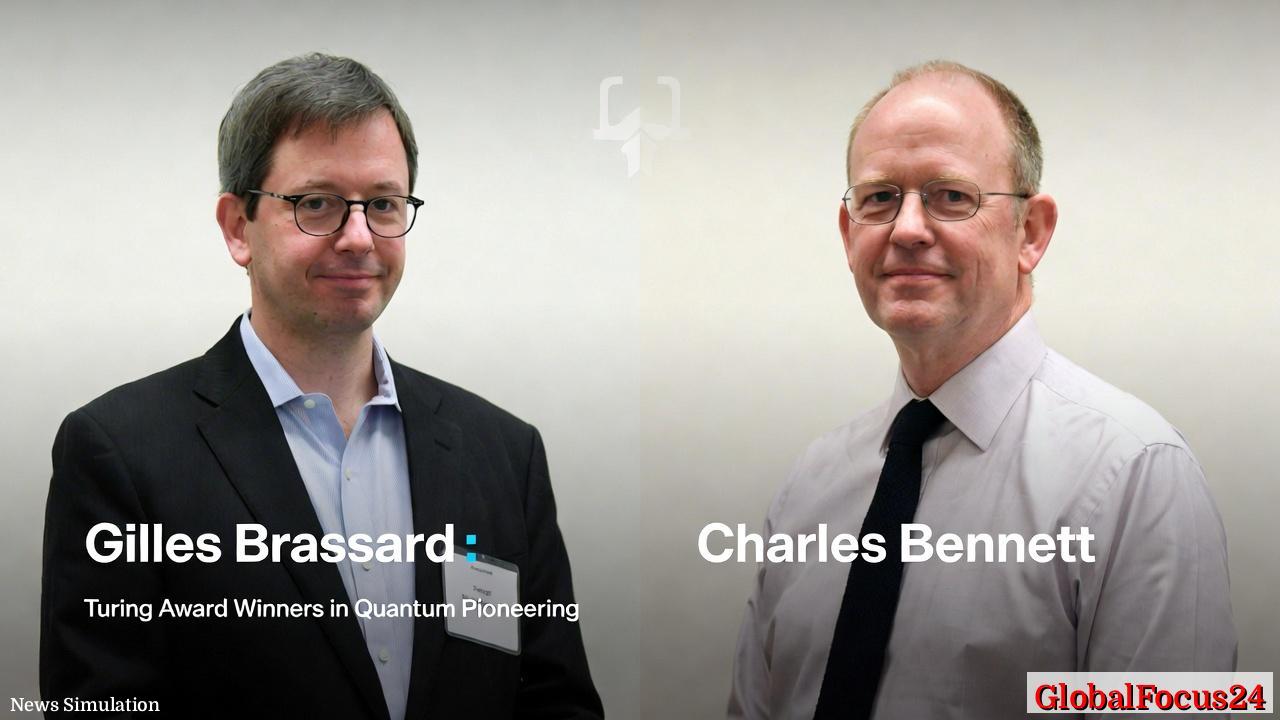
Gilles Brassard and Charles Bennett Win Turing Award for Pioneering Quantum Information Science
Landmark Recognition for Quantum Innovation
Gilles Brassard and Charles Bennett have been awarded the A.M. Turing Award, widely regarded as the highest honor in computer science, for their foundational contributions to quantum information science. The pair will share the $1 million prize, marking the first time the award has recognized breakthroughs rooted in quantum physics.
Their work, spanning decades of theoretical insight and experimental validation, has reshaped the understanding of computation and secure communication. Brassard, a computer scientist at the University of Montreal, and Bennett, a physicist at IBM Research in Yorktown Heights, New York, are credited with transforming quantum mechanics from an abstract scientific framework into a practical tool for information processing.
Origins of Quantum Information Science
The origins of their work trace back to the 1970s, a period when computing was still firmly grounded in classical physics. At the time, researchers were beginning to question whether quantum phenomena—long considered the domain of theoretical physics—could be harnessed for computation.
Brassard and Bennett were among a small group of thinkers who explored this possibility. Inspired by early ideas suggesting that quantum systems could encode and process information in fundamentally different ways, they began investigating how quantum effects might outperform classical methods.
Their early research laid the groundwork for what would become quantum information science, an interdisciplinary field that blends physics, mathematics, and computer science. Unlike classical bits, which exist as either 0 or 1, quantum bits, or qubits, can exist in multiple states simultaneously through a property known as superposition. This allows quantum systems to process vast amounts of information in parallel.
Breakthrough in Quantum Cryptography
One of the most influential milestones in their collaboration came in 1984, when Brassard and Bennett developed the first practical protocol for quantum key distribution. The method, often referred to as BB84, introduced a radically new approach to encryption.
Instead of relying on mathematical complexity to secure communications, their protocol used the laws of quantum mechanics. Encryption keys were transmitted using individual photons, with each photon encoding a piece of information. Crucially, any attempt to intercept or measure these photons would alter their quantum state, immediately revealing the presence of an eavesdropper.
This breakthrough addressed a longstanding vulnerability in classical cryptography, where security depends on the assumption that certain mathematical problems are difficult to solve. Quantum key distribution, by contrast, offers security grounded in physical principles rather than computational limits.
Later in the 1980s, Bennett demonstrated the feasibility of this approach through experimental implementation, helping move the concept from theory to practice. Today, quantum cryptography is considered one of the most promising applications of quantum technology, with real-world deployments in sectors ranging from finance to national security.
Quantum Teleportation and Entanglement
In 1993, Bennett, Brassard, and collaborators introduced another landmark concept: quantum teleportation. This protocol enables the transfer of quantum information between distant particles using a phenomenon known as entanglement.
Entanglement occurs when two particles become linked in such a way that the state of one instantly influences the state of the other, regardless of distance. Quantum teleportation leverages this connection to transmit the state of a qubit without physically moving the particle itself.
While the term “teleportation” evokes science fiction, the process does not involve transporting matter. Instead, it transfers information with perfect fidelity, provided the entangled system is maintained. This concept has become a cornerstone of quantum networking and distributed quantum computing.
The introduction of quantum teleportation demonstrated that quantum systems could enable entirely new forms of communication and computation, further solidifying the field’s potential.
From Skepticism to Global Investment
In the early years of their research, Brassard and Bennett faced skepticism from parts of the scientific community. At the time, it was not widely accepted that quantum effects could offer practical advantages over classical approaches.
Bennett has noted that their ideas were initially viewed as unconventional, if not speculative. However, as experimental techniques improved and theoretical frameworks matured, the value of their work became increasingly evident.
By the early 21st century, quantum information science had evolved into a major area of research, attracting significant investment from governments and private industry. Today, countries including the United States, China, Canada, and members of the European Union are investing billions of dollars in quantum technologies.
Economic Impact and Industry Growth
The economic implications of quantum information science are substantial. Quantum computing, in particular, is expected to transform industries that rely on complex calculations, such as pharmaceuticals, materials science, logistics, and finance.
Potential applications include:
- Accelerating drug discovery by simulating molecular interactions at unprecedented scale.
- Optimizing supply chains and transportation networks with advanced algorithms.
- Enhancing financial modeling and risk analysis.
- Developing new materials with tailored properties for energy and manufacturing.
Quantum communication technologies, including secure quantum networks, are also poised to play a critical role in safeguarding sensitive data in an era of increasing cyber threats.
Industry leaders such as IBM, Google, and emerging startups are racing to build scalable quantum computers. Meanwhile, telecommunications companies are exploring quantum networks that could underpin future internet infrastructure.
Analysts estimate that the global quantum technology market could reach tens of billions of dollars within the next decade, driven by both public and private investment.
Regional Developments in Quantum Research
The advancement of quantum information science has taken on a distinctly global character, with different regions pursuing complementary strategies.
In North America, the United States has focused on large-scale research initiatives and public-private partnerships, supported by federal funding and major technology companies. Canada, home to Brassard, has established itself as a leader in quantum research through institutions such as the University of Waterloo and its Institute for Quantum Computing.
Europe has emphasized collaborative research across member states, with programs aimed at building a unified quantum ecosystem. The European Union’s Quantum Flagship initiative represents one of the largest coordinated efforts in the field.
China has made rapid progress, particularly in quantum communication. The country has launched quantum satellites and built extensive fiber-based quantum networks, demonstrating capabilities in secure communication over long distances.
These regional efforts reflect both cooperation and competition, as nations seek to secure strategic advantages in a technology widely viewed as transformative.
Lasting Scientific Legacy
The recognition of Brassard and Bennett with the Turing Award underscores the enduring impact of their work. Their contributions have not only established a new scientific discipline but also redefined the limits of what is possible in computing and communication.
Brassard has described the award as a deeply meaningful acknowledgment of a lifetime of research, while Bennett has reflected on the journey from early skepticism to widespread acceptance.
Their achievements highlight the importance of interdisciplinary collaboration, as their work bridged the gap between theoretical physics and practical computing. By demonstrating that quantum mechanics could be harnessed for information processing, they opened the door to innovations that continue to unfold.
The Future of Quantum Technologies
As quantum technologies move closer to practical deployment, the foundations laid by Brassard and Bennett remain central to ongoing research and development.
Challenges persist, including the need to build stable, error-corrected quantum systems and to scale up existing prototypes. However, progress in these areas continues at a steady pace, driven by advances in hardware, algorithms, and experimental techniques.
The principles established by their work—quantum superposition, entanglement, and secure communication—are now integral to a rapidly evolving technological landscape.
With the Turing Award recognition, the field of quantum information science has reached a new level of visibility, signaling its transition from theoretical exploration to real-world impact.