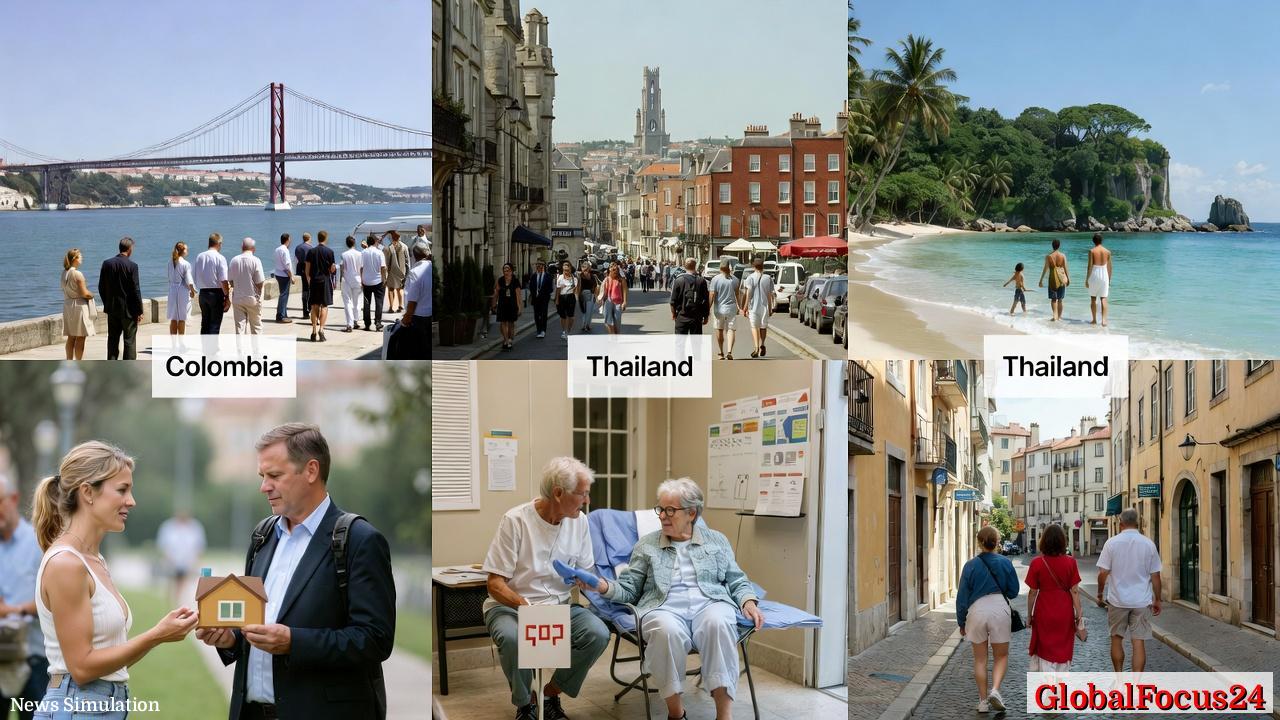
Americans Moving Abroad in Record Numbers as High U.S. Incomes Enable Global Lifestyles
A Historic Shift in U.S. Migration Patterns
In its 250th year, the United States is facing a migration reversal not seen since the Great Depression. For the first time in nearly a century, more people left the country than entered it. Net negative migration reached an estimated 150,000 people in 2025, and the number is expected to rise further in 2026, according to new analyses of international residency data.
This modern exodus is powered less by economic despair and more by affordability and quality-of-life aspirations. Americans, backed by some of the world’s highest average salaries, are finding that their incomes translate into comfortable, even luxurious, lifestyles abroad — from European capitals to tropical enclaves in Southeast Asia and Latin America.
Lisbon, Dublin, and Bali: Hubs of the New American Diaspora
Across Europe and beyond, the presence of U.S. citizens has become increasingly visible. In Lisbon’s cobblestoned neighborhoods, English-language conversations and American coffee shops are now commonplace. Local housing agents estimate that home purchases by Americans have quadrupled since 2020. Many new arrivals cite Portugal’s mild climate, relaxed pace, and relatively low cost of living compared to the coastal United States.
In Ireland, Americans are reconstituting small urban enclaves, particularly in Dublin’s Grand Canal Dock area. Official data suggest that one in every fifteen residents there was born in the United States — a remarkable figure for a city once defined by outward Irish migration. “It feels like a cultural exchange in reverse,” one longtime resident said, noting a surge of professionals working remotely for U.S. companies.
Meanwhile, in regions like Bali, Medellín, and Chiang Mai, the local welcome has been more complicated. Dollar-paid American remote workers have driven up rental prices, sparking local protests about affordability. Similar friction is emerging in Colombia’s coastal cities, where American demand has tightened housing markets traditionally accessible to locals.
Studying and Retiring Overseas
Education and retirement migration are also fueling the surge. More than 100,000 young Americans are enrolled in foreign universities today, drawn by significantly lower tuition costs and increasingly internationalized degree programs. In many European nations, undergraduate degrees cost less than a single semester at a U.S. private college, prompting families to rethink the value of domestic higher education.
At the other end of the age spectrum, retirees are crossing borders for affordable care. Nursing and assisted-living homes along Mexico’s northern border have reported a growing influx of U.S. citizens. Monthly care costs often run less than half of what comparable facilities charge in the United States, making cross-border retirement a practical alternative.
A New Industry Built Around American Mobility
The migration wave has spurred the rise of a relocation industry catering to Americans seeking second lives abroad. Companies that once specialized in corporate postings now organize “scouting trips” for everyday professionals planning permanent moves. One relocation firm based in Austin said it led 57 group tours in the past year alone—up from three trips the previous year—and has set an ambitious goal of assisting one million Americans to resettle overseas in the next decade.
The movement is no longer limited to adventurous digital nomads. Today’s emigrants include architects, engineers, financial advisers, and families exploring stable, safer lifestyles. The remote-work revolution has redefined geographic boundaries, enabling skilled professionals to maintain U.S.-level incomes while living in countries with lower living costs.
The Surge in Citizenship and Residency Applications
To secure their futures abroad, many Americans are pursuing foreign residency or citizenship at unprecedented rates. Consulates in Europe report months-long backlogs in processing applications. The number of Americans granted British citizenship in 2025 was the highest since records began in 2004. Irish passport issuances to U.S. residents hit a record 40,000, reflecting both heritage claims and pragmatic planning.
Globally, nearly every European Union country has reported record numbers of U.S. residents. Portugal’s American population has ballooned by over 500 percent since the pandemic, growing another 36 percent in 2024 alone. Spain and the Netherlands have nearly doubled their American communities over the last decade. The Czech Republic, once a niche expatriate destination, has seen its numbers more than double. Germany and Ireland now host more migrating Americans annually than citizens of those nations move to the United States.
Families Building New Lives Abroad
Unlike earlier waves of temporary expatriates, recent emigrants often intend to stay permanently. Families are enrolling children in local schools, participating in sports leagues, and integrating into civic life. One parent in Berlin noted that while wages remain higher in the U.S., the perceived day-to-day safety and social atmosphere make life more fulfilling abroad. “Here, my kids walk to school without fear,” she said. “There are no active shooter drills. It’s a different reality.”
These families often point to tangible benefits — shorter workweeks, reduced healthcare costs, and greater access to child care — as key reasons for staying abroad long term. Remote work allows them to remain professionally connected to the U.S. economy while benefiting from European social infrastructure.
The Role of Remote Work and Lifestyle Economics
Remote jobs have become the great enabler of global relocation. With U.S. employers increasingly accepting distributed teams, a growing share of employees have discovered they can live anywhere with a stable internet connection. For many, this has turned an old fantasy into an attainable plan.
Americans moving abroad find their incomes stretch far further than at home. In countries where rent, healthcare, and transportation are a fraction of U.S. costs, mid-level salaries can deliver upper-middle-class lifestyles. Lisbon, Budapest, and Prague have become prime examples of this phenomenon — where a U.S. remote salary supports central-city living, organic groceries, and international travel.
Even when currency fluctuations make dollars fluctuate in local terms, most expats continue to find overall costs dramatically lower. A New York creative producer who recently relocated to Lisbon said concerns about school safety in the U.S. ultimately cemented his decision. “We realized we could have peace of mind and financial breathing room,” he said. His family now shops at a mix of local and imported stores, gradually blending old habits with a new sense of normal.
Economic Ripples and Local Reactions
The growing American presence abroad is reshaping local economies. Property markets in several European capitals now track “expat premiums” tied to foreign demand. In Portugal, local activists have pressed for higher taxes on nonresident buyers, while other governments are tightening short-term rental licenses to stabilize neighborhoods.
At the same time, foreign income contributes significantly to local economies. In southern Spain and coastal Mexico, American retirees and professionals support restaurants, property maintenance companies, and community events. Economists note that U.S. inflows of capital often cushion local business cycles, especially in tourism-heavy regions.
Still, questions remain about sustainability. Rising prices and gentrification have spurred calls across Europe and Southeast Asia to balance the benefits of expatriate spending with protections for local affordability. Policymakers across Portugal, Thailand, and Colombia are debating measures to regulate digital nomad visas, aiming to strike a balance between openness and economic fairness.
Comparisons and Historical Context
Historically, U.S. departures have never outweighed arrivals on this scale. Even during the post-World War II reconstruction era, emigration remained minimal. The last time the country recorded comparable net outflows was during the 1930s, when the Great Depression forced many Americans to seek work abroad.
The present movement, however, has a markedly different character. Rather than being driven by unemployment or poverty, today’s emigrants are leveraging global opportunity. Strong salaries, combined with inflation and cost-of-living pressures at home, have shifted the calculus for middle-class Americans. The rise of dual citizenship rights and simplified visa schemes in the European Union, Latin America, and Asia has accelerated the process.
A Redefined American Dream
For a growing number of citizens, the American Dream no longer requires living in America itself. The U.S. remains an economic powerhouse, but its prosperity now sustains a global class of mobile professionals and retirees seeking balance, security, and affordability elsewhere.
Analysts suggest this trend may define a new chapter in global migration — one where economic privilege fuels outward movement rather than attraction inward. With more Americans renouncing citizenship or taking dual nationality, the symbolic meaning of national belonging is evolving alongside modern labor and lifestyle patterns.
Whether driven by cost, safety, or aspiration, millions of Americans now see the world not as an escape from their homeland, but as an extension of what U.S. success enables. As the nation marks its 250th year, its citizens are redrawing the map of what it means to live the American life — one apartment, one school, and one family at a time, far beyond U.S. borders.