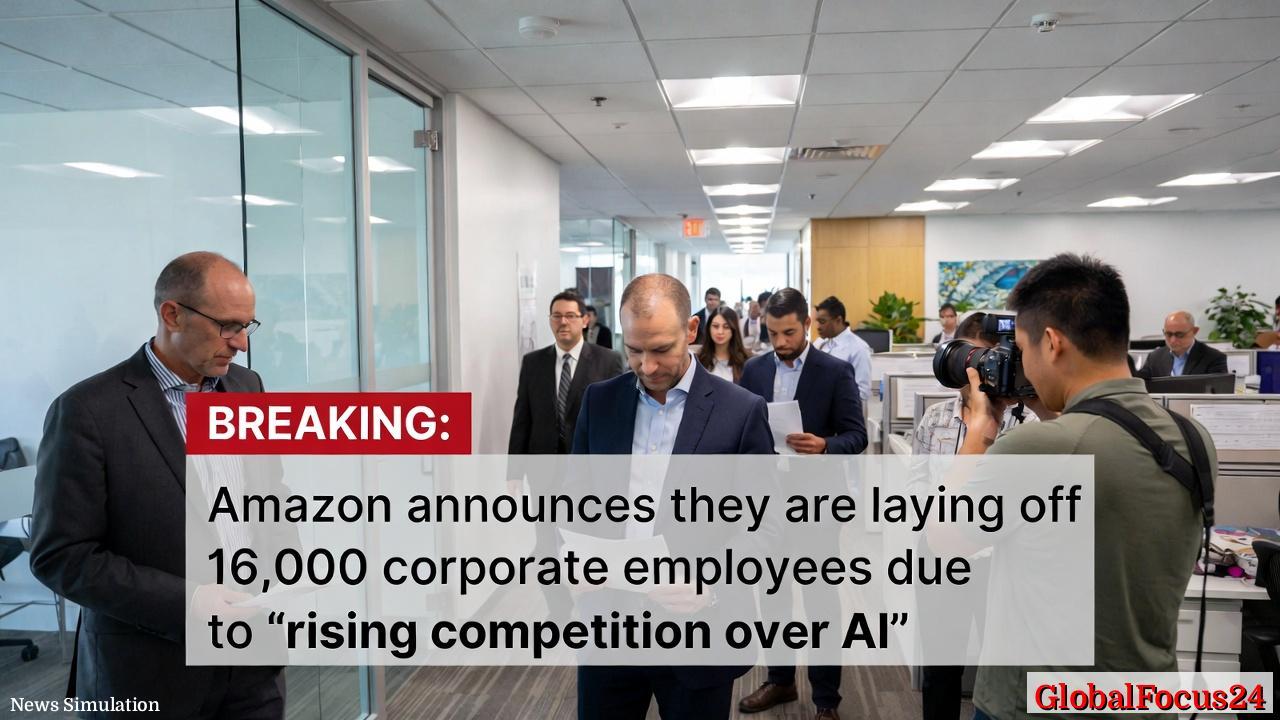
Amazon Announces 16,000 Corporate Layoffs as AI Competition Intensifies
Amazon is initiating a major workforce reduction, eliminating 16,000 corporate roles as the company doubles down on artificial intelligence capabilities amid intensifying competition in the tech and AI sectors. The move, announced in a formal corporate release and communicated to employees and investors, signals a broad recalibration of the company’s cost structure and strategic priorities. The layoffs target non-operational positions across multiple corporate functions, with leadership emphasizing a renewed focus on technology, product development, and long-term platform investments.
Context and historical backdrop
The decision arrives against a backdrop of rapid AI advancement and evolving expectations around how large technology platforms should operate in the AI era. Amazon’s pivot follows a recent surge in AI-centric investments across the sector, including sizable commitments from cloud providers, consumer tech firms, and e-commerce platforms that increasingly rely on AI to optimize logistics, personalization, and competitive differentiation. Historically, Amazon has navigated cycles of expansion and consolidation, deploying capital into research and development, cloud services, and logistics infrastructure to sustain growth in a highly competitive landscape. The current layoff wave marks a continuation of that pattern, reflecting a strategic shift rather than a broad retrenchment.
Economic implications and regional impact
The announced reductions carry significant implications for shareholders, employees, and regional economies tied to Amazon’s operations. In the near term, the company cites the need to streamline operations, reduce fixed costs, and reallocate resources toward AI-driven initiatives, cloud capabilities, and machine-learning platforms that underpin major business lines—from e-commerce recommendations to supply chain optimization and massive data processing in cloud environments. The economic ripple effects extend beyond the company’s balance sheet; employees exiting corporate roles may require transition support, severance packages, and retraining opportunities that influence local job markets, housing, and consumer spending in regions with substantial Amazon presence.
For regions with dense corporate campuses or sizable urban hubs hosting Amazon’s administrative operations, the layoffs could translate into a notable shift in employment mix. Yet the company also notes ongoing hiring in other areas, particularly in roles tied to technology development, analytics, and cloud engineering where strategic priorities remain robust. This dynamic highlights a broader trend in which large platforms reprioritize workforces to align with high-growth domains while maintaining a stable pipeline for essential operational roles.
AI as a strategic anchor
Artificial intelligence emerges as the central axis around which Amazon is reshaping its corporate structure. The company’s leadership has repeatedly underscored AI’s role in enhancing customer experiences, improving supply chain efficiency, and enabling scalable innovations across retail, cloud computing, and logistics networks. By reallocating resources toward AI-oriented projects, Amazon aims to accelerate product roadmaps, shorten development cycles, and strengthen competitive moats in an environment where rivals are heavily investing in machine learning, large language models, and automation.
The strategic emphasis on AI aligns with broader industry trajectories. Competitors across cloud, consumer electronics, and retail platforms are racing to deploy advanced AI capabilities that can automate customer service, optimize pricing and recommendations, forecast demand, and streamline fulfillment networks. In this context, the layoff move can be viewed as a recalibration to concentrate human capital on core AI-driven differentiators, rather than dispersing talent across a wide array of initiatives with less near-term payoff.
Operational efficiency and investment priorities
The company’s statement outlines a plan to realign leadership and resources, prioritizing engineering, product management, and AI research, while seeking to improve efficiency across corporate operations. Analysts have noted that such realignments, if executed with precision, can reduce overhead and enable faster iteration cycles for AI-enabled products and services. The emphasis on cloud computing and AI tooling is particularly salient, given Amazon Web Services’ position as a leading platform for developers and enterprises seeking scalable AI infrastructure and data processing capabilities.
From an investor relations perspective, the reallocation signals confidence that AI-led productization can sustain long-term revenue growth even if near-term restructuring adds volatility. Historically, investors have rewarded companies that can demonstrate durable competitive advantages built on scalable technologies, even when short-term cost cuts weigh on earnings per share. The balance between cost discipline and aggressive investment in AI will likely shape market reception in the days and weeks ahead.
Regional comparisons and market dynamics
When viewed through a regional lens, the decision echoes patterns seen in other major tech hubs where firms have adjusted headcount to match shifting technology priorities. In tech-centric regions, including parts of the United States, Europe, and Asia, firms frequently recalibrate labor mixes to align with high-growth domains such as AI, cloud services, and autonomous systems. This reallocation often coincides with localized programs for talent retraining and partnerships with technical institutions, aiming to ease transitions for workers impacted by corporate redesigns.
In comparison to peers that pursued similar AI emphasis strategies, Amazon’s move reflects a measured approach to scale back corporate overhead while preserving and expanding key growth engines. For communities dependent on corporate headquarters and ancillary services, the announcement underscores the importance of resilience and diversification; such regions may increasingly seek to attract talent in AI research, software development, and data analytics to offset shifts in traditional roles.
Customer experience, innovation, and logistics implications
From the customer perspective, the AI-centric shift is expected to yield enhancements in personalization, search relevance, and predictive delivery, supported by more sophisticated data analytics and machine-learning models. In the logistics domain, AI-enabled optimization can translate to faster fulfillment, improved inventory management, and reduced operational costs, potentially translating into improved service levels and more competitive pricing dynamics. While layoffs can raise concerns about organizational stability, the broader focus on AI investments may contribute to longer-term improvements in reliability and customer satisfaction.
For innovation ecosystems, the move reinforces the centrality of AI as a driver of new products and services. Startups and established technology firms alike often monitor large platform moves for signals about investment focus, strategic partnerships, and potential collaboration opportunities. The AI emphasis can spur acceleration in adjacent sectors, including edge computing, data governance, and responsible AI practices that ensure scalable, ethical deployment of advanced models.
Public reaction and social considerations
Public sentiment toward corporate layoffs is typically mixed, balancing empathy for workers with recognition of strategic necessity from the company’s standpoint. Communities that host affected employees may respond with a combination of concern for immediate employment prospects and interest in retraining initiatives. Social programs and local government support can play a role in smoothing transitions, offering continued access to education, job placement services, and new career pathways in technology and digital services.
As AI continues to reshape job markets, ongoing dialogue among policymakers, educators, and industry leaders is essential to prepare the workforce for evolving skill requirements. Proactive investment in reskilling, apprenticeship programs, and STEM education can help mitigate the short-term disruption associated with large-scale corporate changes while preserving long-term innovation momentum.
Operational timelines and next steps
The company has indicated a structured transition plan designed to minimize disruption while advancing AI-focused objectives. The immediate term involves redeploying or separating affected personnel, implementing severance terms, and providing support for career transitions. In the mid term, leadership plans to accelerate AI-driven product development, expand cloud-based AI tools, and integrate advanced analytics more deeply into consumer and enterprise offerings. The longer-term outlook envisions a leaner corporate structure with a reinforced focus on core AI platforms, data infrastructure, and scalable technology services that support Amazon’s broad business portfolio.
Industry-wide implications
The layoff announcement contributes to a broader industry narrative about the evolving employment landscape in the technology sector. As firms increasingly anchor growth in AI and automation, workers with expertise in machine learning, data science, software engineering, and cloud architecture may experience sustained demand. Conversely, roles that are more administrative or duplicative across corporate functions may face greater volatility. This dynamic underscores the importance of continuous learning, cross-functional mobility, and strategic career planning for professionals navigating a fast-changing tech ecosystem.
Historical performance indicators and investor outlook
From a historical perspective, Amazon’s earnings and revenue trajectories have demonstrated resilience amid shifting market conditions and strategic realignments. Investors typically weigh the quality of leadership, the clarity of long-range plans, and the anticipated impact of AI investments on monetization, platform scale, and ecosystem depth. While workforce reductions can pose near-term earnings headwinds, successful execution of AI-driven initiatives has the potential to unlock additional revenue streams and improve efficiency over time. Market analysts will scrutinize cost savings, capital expenditure, and the tempo of AI product rollouts in the weeks following the announcement.
Conclusion: charting a course through transition
The decision to lay off a substantial portion of corporate staff marks a significant moment in Amazon’s ongoing evolution as a technology platform. By prioritizing AI and related capabilities, the company aims to strengthen its competitive position in a rapidly changing landscape. The layoff isn’t merely a cost-cutting measure; it reflects a strategic bet on capabilities that executives believe will drive growth, innovation, and improved customer experiences in the years ahead. For employees, communities, and partners, the transition will require careful navigation, with attention to retraining opportunities, displaced worker support, and new pathways to participate in the next phase of Amazon’s technology-driven expansion. In the broader market, the move signals a continued emphasis on AI as a central driver of corporate strategy, potentially shaping industry benchmarks for efficiency, product development, and scale in the digital economy.