AI Weather Forecasting Sparks Global Debate Over Accuracy in Extreme Events
Changing Forecasts in a Changing Climate
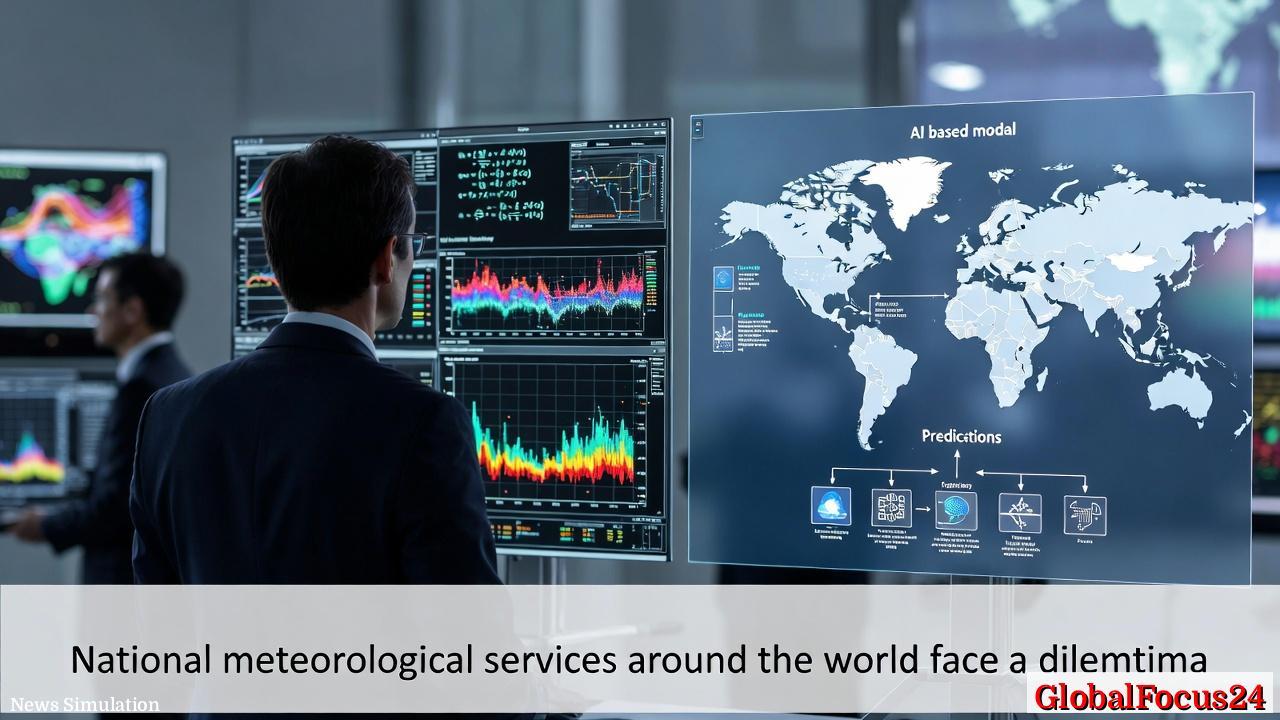
National meteorological services worldwide are facing a pivotal dilemma. Artificial intelligence–based weather forecasting models now offer predictions that are faster and cheaper than traditional systems, but their reliability during extreme weather remains uncertain. Across Europe, Asia, and the Americas, agencies are rethinking the balance between innovation and trust as AI reshapes the foundations of modern forecasting.
For decades, weather modeling has been built on physics. Equations rooted in the laws of motion and thermodynamics simulate how heat, pressure, moisture, and wind move through the atmosphere. These models, enhanced with satellite and ground-based data, have saved lives and billions of dollars by predicting hurricanes and typhoons with unprecedented lead times. Since the 1970s, the number of global cyclone deaths has dropped dramatically, thanks to better models and coordinated evacuations.
But a new chapter is unfolding. Artificial-intelligence models do not calculate the physics of the atmosphere. Instead, they learn patterns from past weather and use those patterns to predict the future directly. The results can be impressive—and unsettling.
The Promise of Artificial Intelligence Forecasting
The core advantage of AI weather models lies in speed and scalability. Once trained on enormous datasets that capture decades of global weather, an AI system can generate a 14-day forecast in minutes. By contrast, physics-based models require powerful supercomputers running complex calculations that can take hours, even on the fastest systems.
Researchers estimate that AI-driven forecasts are produced at a fraction of the operational cost of traditional systems. In regions with limited computing resources—such as smaller national meteorological agencies in Africa, South America, and the Pacific—AI methods could dramatically expand access to reliable medium-range predictions.
In 2023, several early studies showed that leading AI weather models, including those trained by major technology companies and research institutes, achieved accuracy comparable to or better than mainstream operational models in predicting large-scale atmospheric patterns. When tested over Europe and North America, these systems performed especially well for common weather events such as routine rainfall, daily temperature ranges, and standard storm tracks.
The European Centre for Medium-Range Weather Forecasts (ECMWF) has already begun integrating AI outputs into its daily operations. Hybrid systems now pair traditional data assimilation with AI-based analyses, allowing meteorologists to compare and validate both approaches. The U.K. Met Office, Japan Meteorological Agency, and U.S. National Weather Service have launched similar collaborations.
The Reliability Challenge: When Extremes Break the Pattern
Yet the same strengths that make AI fast and adaptable also expose its weaknesses. Because these models rely entirely on learned patterns, they may falter when confronted with events that deviate from anything seen before. As climate change pushes weather far outside historical norms, such unpredictability becomes a growing problem.
Recent studies show that AI models handle typical tropical cyclones with remarkable skill. Their forecasts for track and intensity often match those from physics-based models up to five days in advance. But for unprecedented or record-breaking storms—such as the North Atlantic’s first Category 6–strength hurricane or Europe’s 2023 heat dome—AI predictions degrade quickly. They underestimate wind speeds, rainfall intensity, and the persistence of anomalies.
A 2025 review of AI forecasts across Asia found a consistent bias toward underestimating the sharpest temperature and wind extremes. This limitation stems from the structure of the training data itself: most extreme events are rare, and thus underrepresented. Without sufficient examples, even powerful neural networks fail to anticipate how far the atmosphere can push beyond established boundaries.
Historical Context: From Equations to Algorithms
The evolution of modern weather forecasting has always been shaped by technology. In the early 20th century, meteorologists relied solely on observational data, plotting fronts and pressure systems by hand. The first computerized forecasts emerged in the 1950s, building on the mathematical insights of the Norwegian cyclone model and the pioneering work of scientist Lewis Fry Richardson. These numerical models revolutionized the field, but they demanded massive computing power.
By the 1970s, advances in satellite observation and supercomputing made global forecasting feasible. Collaborative networks such as the World Meteorological Organization’s Global Telecommunication System allowed nations to share real-time data, giving rise to the integrated global models used today.
Each decade brought greater precision. The probability of determining a cyclone path three days ahead improved from less than 60 percent in the 1980s to over 90 percent by 2020. But accuracy came with cost: major national centers spend hundreds of millions of dollars per year maintaining supercomputers, data streams, and expert teams. AI now promises to cut these costs dramatically while increasing speed—a disruptive innovation reminiscent of the original shift to digital models half a century ago.
Balancing Speed, Cost, and Trust
For national meteorological services, the decision is not merely technological—it is strategic. Adopting AI means balancing efficiency with accountability. When forecasts inform emergency evacuations or disaster response, credibility can save lives.
Agencies like Germany’s Deutscher Wetterdienst and India’s Meteorological Department have voiced cautious optimism. They acknowledge AI’s potential but insist on strict validation procedures before using it for public warnings. In the United States, forecasters emphasize that AI tools currently serve best as “decision support,” complementing rather than replacing physics-based models.
Economically, the impact is vast. Faster, cheaper forecasts could enhance agricultural planning, energy load management, and transportation logistics. But early adoption without reliability could yield false confidence, especially for rare but catastrophic events such as flash floods or polar outbreaks.
Testing the Limits: The AI Retraining Without Iconic Events Framework
To address these concerns, scientists have proposed a standardized evaluation method called the AI Retraining Without Iconic Events (AI-RWIE) protocol. Under this framework, meteorological organizations worldwide would agree on a catalog of historically significant extreme events—major hurricanes, super typhoons, record-breaking heatwaves, and megafloods. These “iconic” events would be deliberately withheld from model training datasets.
AI models would then be tested on their ability to predict these excluded cases accurately. Success would establish a model’s resilience against conditions it has never “seen” before—a crucial benchmark for trust. Failure would highlight the need for retraining or additional data augmentation before public deployment.
The concept mirrors long-standing practices in other industries where safety and reliability are paramount. Aviation regulators, for example, test aircraft in simulated crisis scenarios before certification. Applying similar rigor to weather forecasting could redefine global quality standards for AI models.
Comparing Regional Adoption Strategies
Adoption rates vary widely. Europe, with its strong collaborative institutions, is moving fastest toward operational integration. ECMWF and associated national agencies aim to run AI-supported forecasts alongside traditional models by 2027.
In contrast, the United States maintains a more conservative approach, emphasizing hybrid systems and human oversight. The National Oceanic and Atmospheric Administration (NOAA) has begun exploring machine learning for data assimilation and radar interpretation but has not shifted its core modeling pipeline.
Across Asia, China’s meteorological authorities have launched large-scale AI initiatives powered by domestic supercomputers. Early results show competitive performance, particularly for short-term rainfall forecasts. Meanwhile, smaller island nations in the Pacific view AI as a potential equalizer—a way to access high-quality forecasts without investing heavily in computational infrastructure.
Latin America and Africa represent the greatest growth potential for AI forecasting. Both regions face data scarcity and limited computing capacity but suffer disproportionately from extreme weather. Pilot programs supported by international partnerships aim to deploy lightweight AI systems capable of regional forecasting using open satellite data.
The Road Ahead: Complement, Not Replacement
Experts broadly agree that AI will not replace traditional forecasting methods in the near term. Instead, it is likely to enhance them—offering faster first drafts of global forecasts while physics-based models continue to refine details and validate extremes. Human meteorologists will remain essential to interpret outputs, correct biases, and communicate risks effectively to the public.
Over the next decade, the challenge will be managing coexistence: integrating the unparalleled speed of AI with the dependable accuracy of physics. That partnership may redefine operational forecasting much as radar did in the mid-20th century or satellites in the late 1960s.
A Future Written in the Clouds
The atmosphere is unpredictable by nature, but the tools used to study it are evolving faster than ever. If national weather services can build confidence in AI’s ability to foresee unprecedented extremes, forecasts may soon arrive not only faster but smarter. Until then, each storm, heatwave, or cold front offers a new test of trust in the algorithms now watching the sky.