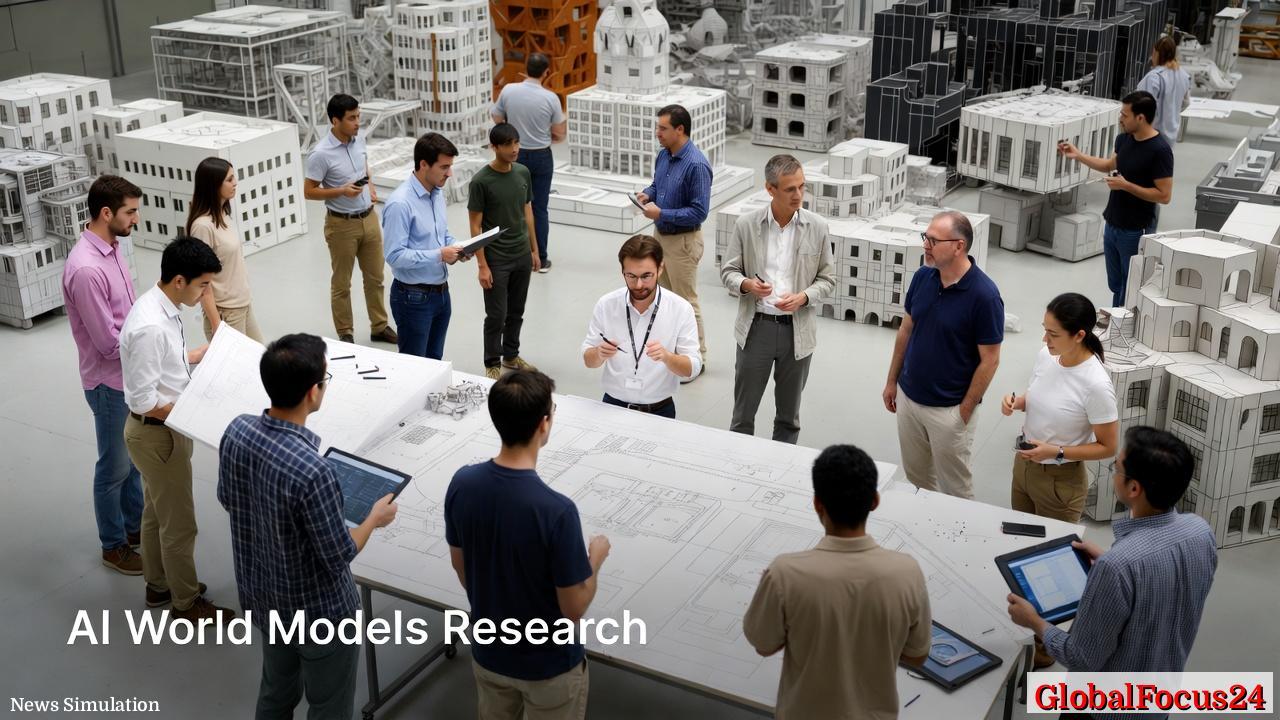
Researchers Race to Develop “World Models” That Could Redefine Artificial Intelligence
Renewed Momentum in Physical Understanding for AI
A quiet but decisive race is unfolding in artificial intelligence laboratories: the pursuit of “world models,” systems designed to teach machines how to understand and predict the physical world. After years of attention focused on large language models that excel at text-based tasks, research interest is circling back toward a more foundational question — how can AI comprehend the environment it inhabits?
World models aim to bridge that gap. While today's leading AI models can generate text, images, and code with remarkable fluency, they largely lack the ability to model real-world dynamics in a consistent way. Understanding motion, cause and effect, and spatial relationships — the essence of physical reasoning — remains one of the field’s hardest frontiers.
Google’s recent release of Project Genie in January marked a turning point, signaling that the industry’s biggest players are committing serious resources to this challenge. The project, still experimental, showcases AI that can learn general representations of physical environments, testing them across different contexts rather than constrained virtual worlds.
This development represents a shift in the broader AI narrative. After a period dominated by ever-larger text models like GPT and Gemini, researchers are now asking what it would take for artificial intelligence to not just describe the world, but truly understand it.
What Are “World Models”?
In essence, a world model is a structured internal representation that allows an AI system to simulate and reason about the real world. These models go beyond image recognition or data pattern matching; they attempt to capture causal relationships and predict outcomes in changing environments.
For example, a world model might "learn" how an object moves when dropped, how light changes across surfaces, or how one action influences another in a chain of events. In robotics, this enables more accurate planning — allowing machines to interact with their surroundings intelligently rather than through trial and error.
The concept is not entirely new. It traces back to early artificial intelligence research in the 1980s and 1990s, when engineers studied how agents could plan or navigate in simulated environments. But computing limits and data scarcity kept progress slow. The explosion of deep learning, coupled with massive datasets and modern simulation tools, has revived the field. Today’s researchers are building models that can learn world dynamics directly from video, game simulations, or sensor data collected by autonomous vehicles.
Three Competing Approaches to World Modeling
Current research generally follows three main paths. The first focuses on data-driven simulation, training AI on large volumes of visual and sensory information to infer the rules of physics implicitly. This approach relies on pattern learning: if an AI sees millions of video frames where objects bounce, roll, or collide, it begins to predict similar outcomes under new conditions.
A second approach is structured modeling, where researchers build explicit representations of physical laws and embed them into neural networks. This method merges classical physics with machine learning, aiming for accuracy and interpretability. The challenge lies in combining the rigor of physics engines with the flexibility of neural systems.
The third — more controversial — strategy questions whether direct world modeling is needed at all. Some experts suggest that advanced multimodal models, equipped with enough general data and training diversity, might simply learn physical understanding as a byproduct rather than an explicit goal. In this view, rather than manually programming or simulating physical interactions, a sufficiently broad neural network might infer those relationships naturally from its exposure to text, images, and video.
Each approach embodies a different philosophy about intelligence itself: whether it should emulate human reasoning structure, rely purely on data scale, or blend the two through learned abstractions.
The Economic Stakes Behind the Research
The drive to develop world models is not merely academic. The economic implications are substantial, touching sectors from robotics and logistics to gaming, manufacturing, and defense. Understanding physical context is crucial for operational safety and efficiency — particularly in scenarios where machines replace or assist human labor.
For autonomous vehicles, world models could enable more accurate scene prediction, improving decision-making in unpredictable environments like city streets. In manufacturing, smarter robots could handle complex assembly tasks without extensive reprogramming or physical demonstrations. Even in content creation, world-model-based AI could generate realistic physics for virtual environments, revolutionizing video production, gaming, and simulation training.
These technologies could also shift the balance of competition in the AI industry. Firms that successfully integrate robust physical reasoning into their systems will likely hold long-term advantages over purely language-based rivals. This explains why research groups at Google DeepMind, Meta, OpenAI, and numerous university labs are all moving quickly on the same frontier.
According to several analysts, the development timeline for usable world models could mirror the rapid maturation of language models between 2018 and 2023 — a period in which early prototypes grew into transformative commercial tools. If similar momentum occurs in world modeling, a new technological revolution could emerge by the decade’s end.
Historical Context: From Simulated Agents to General Reasoning
Historically, the pursuit of machine understanding has oscillated between symbolic reasoning and statistical learning. In the 1960s and 70s, researchers explored symbolic approaches, constructing hand-coded representations of the world. These efforts, while pioneering, struggled to handle complexity and scale.
By the 2000s, statistical learning overtook classical AI, emphasizing data-driven methods. But the pendulum now appears to be swinging back toward systems that combine both — bringing structured physical reasoning back into the equation. The difference this time is computing power. High-fidelity simulators, 3D datasets, and multimodal neural architectures make it feasible to train large-scale physical models in ways that earlier generations of researchers could only imagine.
Project Genie and other prototypes represent a modern synthesis of these historical threads — the logic of classic AI paired with the scale and flexibility of deep learning.
Challenges: Energy Costs, Scalability, and Alignment
Developing accurate world models is technically formidable and economically demanding. The computational cost of simulating physical systems, especially in 3D environments, is immense. Training models that integrate spatial and temporal reasoning often requires processing petabytes of data — a task that pushes the limits of available hardware and sustainable energy use.
Another major challenge lies in generalization. A world model trained within one environment, such as a virtual city, may falter in another, like a forest or a factory floor. Achieving robust transfer learning — the ability to adapt knowledge to new settings — remains a holy grail for AI engineers.
Finally, researchers must grapple with safety and alignment. A physically competent AI could operate powerful machinery, navigate dangerous zones, or make rapid decisions in critical systems. Ensuring that it acts reliably and ethically will require new frameworks for testing, verification, and human oversight.
Global Landscape: Comparing Regional Efforts
Competition in world-model research spans multiple regions, each contributing distinct perspectives shaped by local priorities. In the United States, companies such as Google DeepMind and Nvidia are leveraging vast computing infrastructure to scale large, multimodal simulations. They focus on integrating visual understanding with robotics and autonomous systems.
Europe emphasizes interpretability and safety, with research centers in Germany, France, and Switzerland exploring transparent, physics-informed modeling techniques. European policymakers have also shown more regulatory caution, advocating standards for ethical use and data provenance.
In Asia, particularly China, Japan, and South Korea, world-model research is closely linked to robotics and industrial automation. Japanese firms are integrating learned world models into humanoid robot programs, while Chinese institutes pursue real-world navigation systems for logistics and manufacturing. These regional distinctions highlight how economic strategy and research culture shape the global AI landscape.
Looking Ahead: Toward Machines That Understand the World
If language models transformed machines into conversational partners, world models could make them collaborative actors — capable of moving, building, and reacting effectively in physical space. This represents a profound step toward general intelligence, one that could redefine the boundaries between digital systems and the material world.
Despite uncertainties, momentum is building. As Project Genie and competing research projects mature, the vision of AI systems that model and predict physical reality is no longer theoretical. It’s becoming an engineering problem — and a race to the finish line.
The next few years will reveal whether machines can truly internalize how the world works, or whether the complexity of physical reality will resist even the most powerful algorithms. What’s certain is that understanding the world — not just describing it — has once again become the defining frontier of artificial intelligence research.