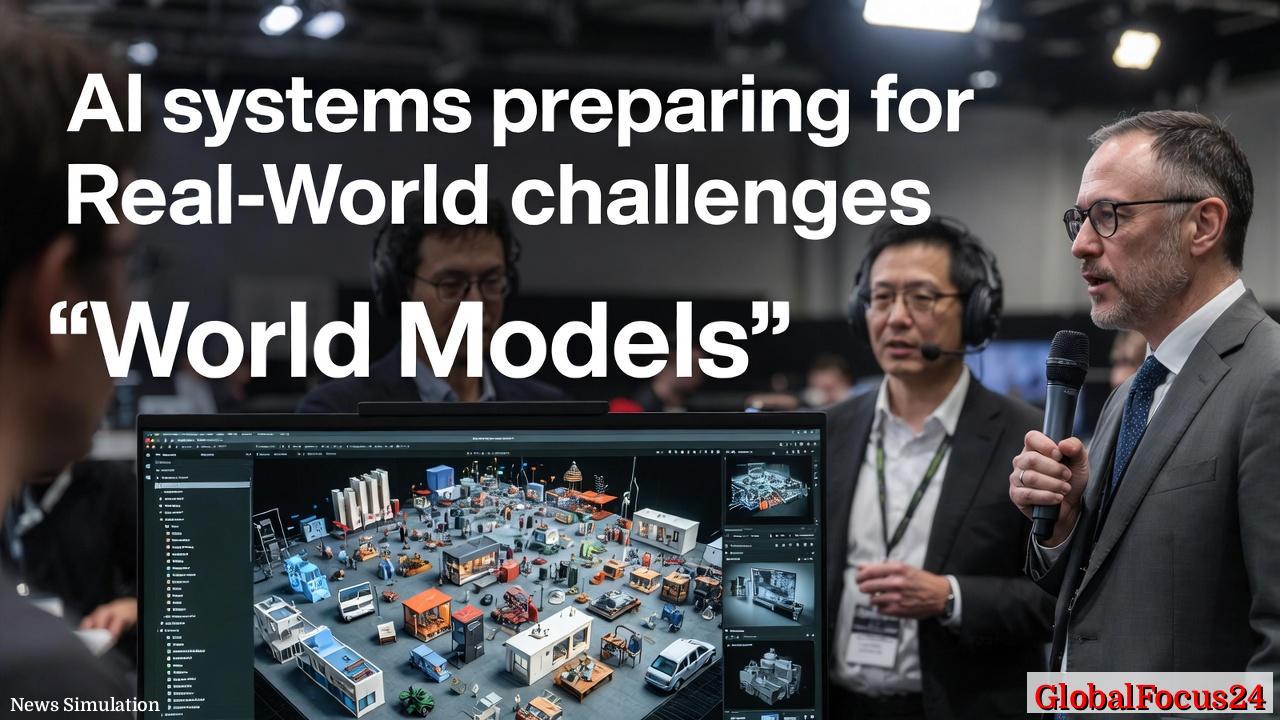
AI Systems Gear Up for Real-World Challenges with "World Models"
Tech Giants Race to Develop Simulations for Physical Environments
In a growing effort to bridge the gap between digital intelligence and physical reality, leading technology companies are turning their research focus toward “world models” — artificial intelligence systems designed to understand and interact with dynamic environments. The concept, long discussed in cognitive science circles, is now emerging as the foundation for the next generation of autonomous AI: robots that can cook, drive, and navigate complex social and physical spaces without constant human guidance.
At the center of this movement is Project GENIE, an experimental model released in January by one of the industry’s largest technology firms. Unlike traditional AI systems limited to text or image generation, Project GENIE allows users to input an image or a short text prompt and receive a fully explorable virtual environment in response. A simple phrase might render a realistic kitchen, while feeding in Georges Seurat’s pointillist masterpiece could produce a living, walkable park filled with sparkling dots of color.
Though it resembles a cutting-edge video game engine, developers emphasize that Project GENIE represents something far more profound: a step toward giving artificial intelligence a true sense of the physical world.
The Birth of "World Models"
The term “world model” traces back to 1943, when Scottish psychologist Kenneth Craik proposed in The Nature of Explanation that the human brain creates small-scale internal models to predict the outcomes of actions before performing them. This mental ability to simulate consequences — imagining dropping a glass before actually doing so — enables prudent decision-making beyond instinctive reaction.
Modern AI researchers see enormous potential in providing machines with a similar capacity. While large language models have captured public attention with their ability to mimic human conversation, experts argue that true intelligence requires situational awareness and internal reasoning about physical processes. A robot operating in the real world, for example, must anticipate the texture of objects it manipulates, the motion of people around it, and the effect of gravity — all factors invisible to current text-based AIs.
Past attempts to build world models date to the 1990s, with early robotics experiments aimed at giving machines basic sensory prediction capabilities. But as machine learning veered toward data-driven pattern recognition, that line of research lingered in the background. Only now, as AI expands beyond screens into homes, streets, and workplaces, has the need for world models reemerged as a defining challenge.
Building Simulated Realities
Three major approaches dominate the race to create usable world models, each offering a distinct path toward intelligent simulation.
1. Video-Based Simulations
The first method builds on the tools of AI video generation, which inherently require coherent internal physics to produce believable motion. Systems like Project GENIE excel by inferring missing details — predicting how a hand might twist a jar lid, or how a ball would bounce across unseen surfaces. This allows models to learn physical interaction indirectly, without constant human annotation.
One of the major advantages of this approach is scale. Because simulated environments can be generated faster and more safely than real-world experiments, AI agents can undergo millions of “training runs” inside virtual worlds before ever touching reality. A self-driving system, for instance, can practice emergency braking scenarios without endangering passengers or pedestrians.
However, video-based methods also face stark limitations. Generated scenes tend to lose consistency outside of the visible frame, creating glitches or illogical transitions when users explore beyond what the AI initially envisioned. Subtle environmental factors like wind, scent, and hidden objects remain challenging to represent, reducing realism in complex interactions.
2. Full 3D World Construction
A second approach, led by researchers like Fei-Fei Li, emphasizes spatial intelligence — the ability to maintain coherent, interactive 3D environments that persist over time. Her company’s new model, Marble, constructs entire virtual spaces from the start, allowing multiple users to navigate, edit, or test them simultaneously.
By starting with a consistent geometry rather than generating scenes frame by frame, Li’s method avoids many pitfalls of video-based systems, providing continuity critical for applications like robotics, architecture, and virtual design. Architects can, for example, explore fully realized digital buildings before ground is ever broken, switching materials and lighting conditions in an instant.
But such models are resource-intensive, demanding enormous computational power and memory to preserve every detail. Further, creating environments accurate enough to reflect real-world physics remains a steep technical challenge.
3. Cognitive Simulation and Abstract Modeling
A third camp, championed by Yann LeCun, takes a more abstract view. His Joint-Embedding Predictive Architecture (JEPA) aims not merely to model physical settings but to simulate invisible systems — universities, bureaucracies, or economies — through learned predictive structures. LeCun argues that intelligence depends more on anticipating outcomes than rendering images.
JEPA allows AI to plan over long horizons without “watching” every intermediate state, parallel to how humans can imagine achieving a goal without visualizing each step. After departing a major social media company in late 2025, LeCun founded a venture focused on expanding this idea, partnering with healthcare groups to design AI assistants that navigate complex medical and administrative workflows.
Hidden World Models in Language Systems
Some experts, including Ilya Sutskever, cofounder of a major AI research lab, contend that existing large language models already possess rudimentary world models within their neural structures. He argues that these systems, trained on immense quantities of human text, compress descriptions of reality into operational principles that enable prediction and reasoning.
In a 2023 experiment, researchers demonstrated that a model trained solely on the game of Othello implicitly stored an internal board state, even though no visual data were provided. The model could identify valid moves and respond appropriately when that representation was altered. This finding suggests that large-scale learning naturally fosters a kind of spatial and logical world understanding.
Further studies on model interpretability have detected clusters of artificial neurons responding to abstract human concepts — such as guilt, spatial boundaries, or landmarks — implying emergent grounding in real-world features. Still, these models lack physical memory or environmental continuity. As Fei-Fei Li and others point out, they may “know” about rivers and trees but have never “felt” gravity or spatial drag, leaving their understanding purely symbolic.
The Economic Stakes of Synthetic Worlds
The development of world-modeling technologies carries implications far beyond research labs. The global robotics and simulation sector is projected to exceed hundreds of billions of dollars over the next decade, driven by applications in logistics, manufacturing, health care, and autonomous mobility. Accurate virtual environments can drastically cut costs and time: self-training robots may replace months of real-world testing with hours of simulated learning.
For leading tech companies, these systems mark a transition from digital assistants to physical collaborators. A humanoid robot with an embedded world model could stock store shelves, assist the elderly, or perform maintenance tasks in remote environments — all without step-by-step programming. Energy companies envision autonomous units for pipeline inspection; agricultural firms see drones that can reason about ecosystem conditions in real time.
The economic ripple effects may mirror those of the industrial internet in the early 2010s, as simulation infrastructure spurred entirely new service industries. If successful, world models could become as foundational to physical automation as cloud computing was to software.
Regional Momentum and Industry Competition
Across regions, development strategies reflect distinct economic priorities. The United States remains the dominant hub for cognitive and simulation-based models, thanks to its concentration of AI research talent and private funding. Silicon Valley firms lead in multi-agent testing platforms, leveraging their experience with gaming engines and large-scale cloud computing.
In Asia, major investments flow toward robotics-integrated world modeling. Japanese and South Korean companies focus on precision manufacturing and eldercare applications, while Chinese firms race to create unified ecosystems linking industrial robots, smart cities, and autonomous logistics. Europe, meanwhile, emphasizes safety and interoperability standards, prioritizing ethical deployment of embodied AI in daily life.
This regional diversification could accelerate adoption globally, as strategically different approaches — from simulation-heavy to physics-grounded — feed insight into one another. Yet experts warn that fragmentation may also slow progress if competitive pressures lead to incompatible frameworks.
From Simulation to Embodiment
The ultimate test of world models lies in their transferability: can an AI trained entirely in simulation perform safely and effectively in the real world? Researchers are now exploring sim-to-real learning, refining models until a robot’s simulated behavior aligns closely with physical outcomes. This process demands ever more detailed representations of reality, pushing the limits of both software and hardware.
Progress on that front may define the next era of artificial intelligence. As systems gain the ability to perceive, plan, and act in dynamic, uncertain settings, AI will move from the confines of data centers into everyday environments. Whether in homes, hospitals, or highways, tomorrow’s intelligent machines will not merely process information — they will inhabit living, evolving worlds.
A New Frontier for Artificial Intelligence
The race for functional world models represents more than a technological milestone; it signifies a philosophical shift in how humanity conceives artificial intelligence. Rather than treating machines as tools that process inputs and outputs, researchers now strive to build systems capable of experience — of learning from simulated reality to master the physical one.
The challenges remain immense: ensuring consistency across sensory modalities, maintaining safety, and aligning simulated ethics with real-world consequences. Yet each breakthrough — from Project GENIE’s pointillist landscapes to Marble’s persistent 3D worlds — brings the boundary between imagination and reality closer together.
If language models taught machines to talk, world models aim to teach them to live.