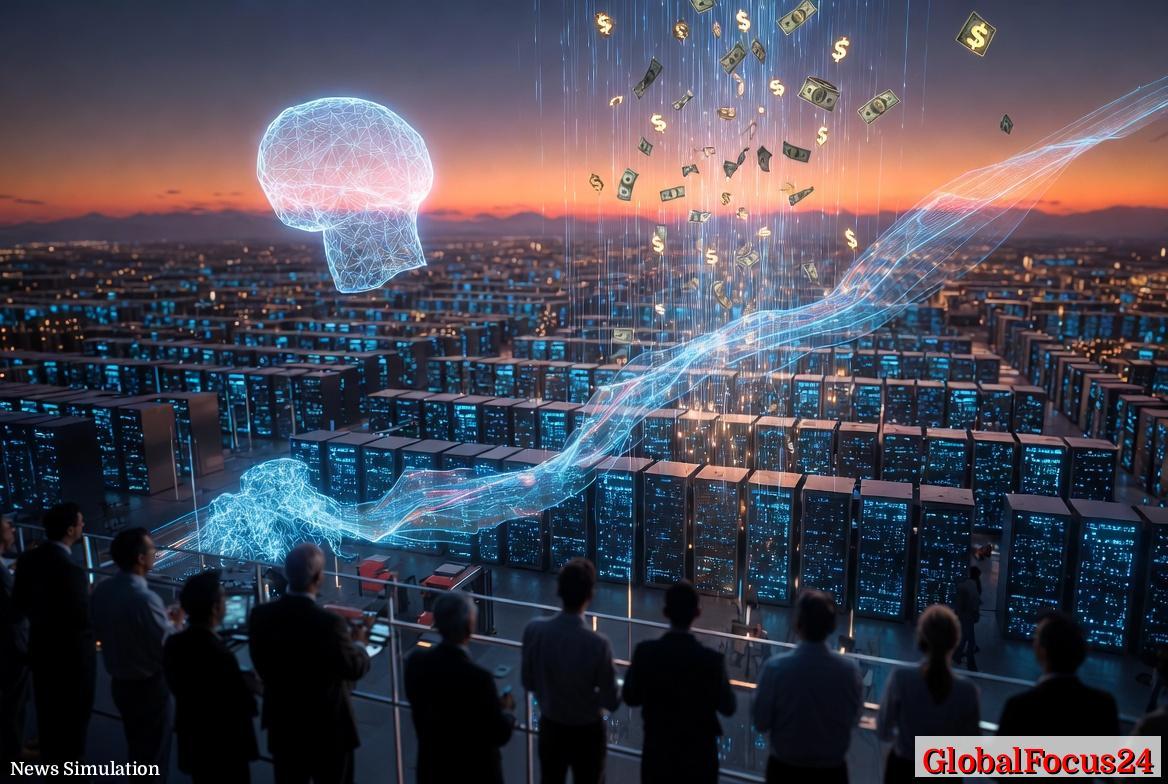
AI-Driven Economic Transformation Accelerates as Computing Power Reshapes Global Growth
A New Era of Machine-Led Innovation
The rapid rise of artificial intelligence and exponential increases in computing power are ushering in a transformative era for the global economy, one that could redefine productivity, labor markets, and wealth creation. Industry leaders in Silicon Valley and beyond are increasingly aligned in their forecasts: AI systems may soon surpass average human performance across a broad spectrum of cognitive tasks, from analysis and design to decision-making and problem-solving.
This shift is not merely incremental. It signals a potential break from historical economic patterns, where human labor and capital investment have long served as the primary engines of growth. With machines capable of improving themselves and accelerating innovation cycles without direct human input, the pace of advancement could exceed anything previously recorded.
Historical Context: From Steam Engines to Neural Networks
To understand the magnitude of this transition, it is useful to compare it with past technological revolutions. The Industrial Revolution of the 18th and 19th centuries mechanized physical labor, boosting productivity in agriculture and manufacturing. The 20th century saw the rise of electricity, computing, and automation, which streamlined industrial processes and introduced the digital economy.
Each of these eras reshaped labor markets and economic structures, but they retained a central role for human input. Even the most advanced software systems required human oversight, programming, and interpretation. Today’s AI systems, particularly those built on advanced machine learning models, challenge that paradigm by demonstrating the ability to learn, adapt, and in some cases improve autonomously.
The concept of machines contributing not only to execution but also to innovation marks a significant departure. Historically, productivity gains depended on human creativity paired with better tools. Now, tools themselves are beginning to generate new ideas, optimize processes, and iterate designs at speeds far beyond human capacity.
The Economics of Accelerating Intelligence
At the heart of this transformation lies a simple but powerful dynamic: compounding technological improvement. As computing systems become more capable, they can be used to design and optimize even more powerful systems, creating a feedback loop of accelerating advancement.
Economists describe this phenomenon as a potential “intelligence explosion,” where gains in machine capability lead directly to further gains without the bottleneck of human learning cycles. If realized, this could dramatically alter the trajectory of global GDP growth.
Key economic implications include:
- Rapid productivity increases across sectors such as finance, healthcare, logistics, and manufacturing.
- Declining marginal costs for digital goods and services, as AI reduces the need for human labor input.
- The emergence of entirely new industries centered on autonomous systems, synthetic data generation, and machine-led research.
Unlike previous technological shifts, which unfolded over decades, AI-driven transformation could compress change into years or even months, amplifying both opportunities and disruptions.
Wealth Creation and Capital Concentration
One of the most striking potential outcomes is the unprecedented speed at which wealth could accumulate. If companies reinvest profits into increasingly powerful AI systems, they may achieve exponential returns on capital. This creates a scenario where economic gains are not only large but also highly concentrated.
Historically, wealth accumulation has been tied to ownership of physical assets such as land, factories, or natural resources. In the emerging AI economy, the most valuable assets may be computational infrastructure, proprietary algorithms, and access to large-scale data.
This shift raises important questions about how wealth is distributed globally. Regions with established technology ecosystems, such as Silicon Valley, Shenzhen, and parts of Western Europe, are likely to maintain a competitive advantage due to their access to capital, talent, and infrastructure.
At the same time, countries that invest heavily in digital infrastructure and education may be able to leapfrog traditional development stages, much as some emerging markets bypassed landline telephony in favor of mobile networks.
Labor Markets in Transition
Perhaps the most immediate and visible impact of advanced AI will be on employment. Unlike earlier automation waves that primarily affected manual or repetitive tasks, modern AI systems are increasingly capable of handling knowledge-based work.
Roles in fields such as customer service, accounting, legal research, software development, and even journalism are already being augmented—or in some cases replaced—by AI tools. As capabilities expand, the range of affected professions is expected to grow.
This transition presents both challenges and opportunities:
- Workers may face displacement in sectors where AI can perform tasks more efficiently.
- New roles could emerge in AI oversight, system design, and human-machine collaboration.
- Education systems may need to adapt rapidly to prepare workers for a changing skill landscape.
The speed of change will be a critical factor. Gradual transitions allow labor markets to adjust through retraining and generational shifts. Rapid disruption, by contrast, can lead to structural unemployment and economic instability if not managed effectively.
Regional Comparisons: Diverging Paths in the AI Economy
The global impact of AI-driven growth is unlikely to be uniform. Different regions are positioned to experience varying outcomes based on their economic structures, policy frameworks, and technological readiness.
In North America, particularly the United States, a strong venture capital ecosystem and leading research institutions have fostered rapid AI development. Companies headquartered in Silicon Valley continue to set the pace in foundational models and large-scale computing infrastructure.
In East Asia, countries such as China, South Korea, and Japan are leveraging AI to enhance manufacturing efficiency and integrate automation into existing industrial systems. China’s large domestic market and centralized investment strategies provide unique advantages in scaling AI applications.
Europe, meanwhile, has emphasized regulatory frameworks and ethical considerations, aiming to balance innovation with safeguards. While this approach may slow certain aspects of deployment, it could also build long-term trust and stability in AI systems.
Emerging economies face a more complex landscape. While AI offers opportunities to accelerate development, limited access to high-performance computing and skilled labor may constrain adoption. However, targeted investments and international partnerships could help bridge these gaps.
Infrastructure and Energy Demands
The expansion of AI capabilities is closely tied to the availability of computing power, which in turn depends on physical infrastructure and energy resources. Data centers, semiconductor manufacturing, and advanced cooling systems are becoming critical components of the global economy.
As demand for computing grows, so does the need for electricity. This has prompted renewed interest in energy efficiency and sustainable power sources. Companies are increasingly investing in renewable energy to support data center operations, while governments are exploring policies to ensure stable and affordable energy supplies.
The interplay between computing growth and energy consumption may become a defining issue in the coming decades, influencing both economic and environmental outcomes.
Public Perception and Societal Impact
Public reaction to AI-driven change is mixed, reflecting both optimism and concern. On one hand, there is excitement about the potential for breakthroughs in medicine, climate modeling, and scientific research. On the other, there are fears about job displacement, privacy, and the concentration of power.
Surveys indicate that awareness of AI is growing, but understanding of its implications remains uneven. This gap underscores the importance of clear communication and education as societies navigate the transition.
Businesses and institutions are also grappling with how to integrate AI responsibly. Questions about transparency, accountability, and reliability are becoming central to discussions about deployment.
The Unpredictable Future of Economic Growth
For most of recorded history, economic forecasting has relied on the assumption that change occurs gradually. Even major disruptions, such as the Industrial Revolution or the rise of the internet, unfolded over extended periods.
The current wave of AI development challenges that assumption. If machines can continuously improve themselves and drive innovation independently, the pace of change could accelerate beyond traditional models.
This introduces a level of uncertainty that is difficult to quantify. Economic indicators that once provided reliable guidance may become less predictive in a rapidly evolving landscape.
At the same time, the potential benefits are substantial. Increased productivity, reduced costs, and new forms of value creation could raise living standards globally. The extent to which these gains are shared—and the speed at which societies adapt—will shape the outcome of this transformation.
A Defining Moment for the Global Economy
The convergence of advanced artificial intelligence and expanding computing power represents a pivotal moment in economic history. While the full impact remains uncertain, the direction of change is clear: a shift toward machine-driven productivity and innovation.
As industries adapt and new economic models emerge, the balance between opportunity and disruption will depend on how effectively governments, businesses, and individuals respond. The coming years may determine not only the trajectory of economic growth but also the structure of the global economy itself.
In this evolving landscape, one principle stands out: the future may no longer resemble the past.