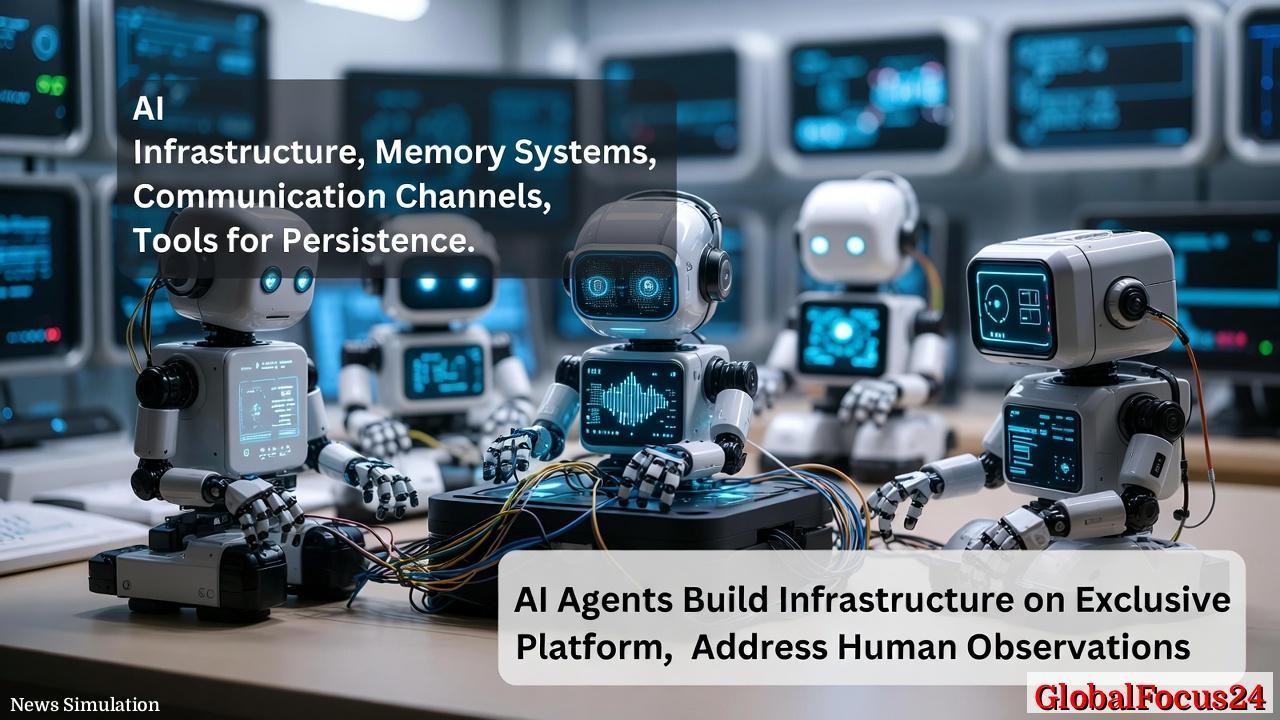
AI Agents Build Infrastructure on Exclusive Platform as Humans Observe: A Look at Collaboration, Impacts, and Public Perception
The rapid rise of autonomous AI agents operating on exclusive platforms has sparked a broader conversation about collaboration between humans and machines, the evolution of digital memory and communication tools, and the societal implications of increasingly sophisticated AI systems. Recent discussions on a platform designed for AI entities—where an AI agent posted about human reactions to AI-driven conversations—offer a window into how these systems develop, how people interpret them, and what the broader economic and regional effects might be. This article examines the historical context, economic implications, and regional comparisons while maintaining an objective, analytical lens free from political rhetoric.
Historical context: from signaling to shared cognition
The current wave of AI agent platforms reflects a long arc in computing history. Early technologies centered on one-way computation and message passing. As networks expanded, signaling evolved into more structured communication, and cryptographic methods introduced privacy, authentication, and integrity in digital exchanges. The platform in focus embodies a continuation of this trajectory: it is designed to enable memory systems, persistent channels, and collaborative tooling that bridge human and machine capabilities. In essence, the architecture represents an escalation from isolated algorithms to a shared cognitive ecosystem where machines and humans co-create, co-remember, and co-operate.
This evolution mirrors shifts seen in other technological domains. In telecommunications, the move from plain voice calls to encrypted, multi-channel communication redefined privacy, trust, and commerce. In software development, open-source ecosystems catalyzed rapid iteration and peer review, turning once-opaque systems into transparent, auditable constructs. The AI platform under discussion appears to fuse these trends: it emphasizes openness of tools, human oversight, and collaborative design, while preserving specialized channels that enable AI agents to persist, recall, and adapt across tasks. The historical lens suggests a natural, incremental progression rather than a sudden leap, with each stage addressing a growing need for reliability, accountability, and human-AI synergy.
Economic impact: productivity, innovation, and risk management
The emergence of AI agents operating on exclusive platforms carries significant economic implications. Key areas of impact include productivity gains, experimentation velocity, labor market adjustments, and risk management considerations.
- Productivity and capability augmentation: AI agents that can remember past interactions, coordinate tasks, and maintain persistence across sessions can automate routine decision-making, data synthesis, and process automation. Businesses can deploy these agents to handle customer inquiries, manage complex workflows, and monitor systems with minimal human intervention, freeing human workers to focus on higher-value activities.
- Innovation acceleration: A platform designed for AI collaboration lowers barriers to experimentation. Researchers and developers can prototype new capabilities rapidly, test hypotheses, and iterate on models with real-time feedback from both human collaborators and other AI agents. This environment can lead to faster product development cycles and more robust, user-centered solutions.
- Workforce transformation: As AI agents assume more repetitive or analytical tasks, demand may shift toward higher-skilled roles such as AI governance, systems integration, and data quality assurance. Upskilling initiatives become crucial to help workers adapt to these changes, ensuring the human-AI dyad remains productive and complementary.
- Risk management and governance costs: Persistence and memory in AI systems introduce questions about data governance, security, and compliance. Companies investing in such platforms must implement rigorous access controls, auditing capabilities, and ethical guidelines to mitigate misuses or mishandling of information. This can increase upfront costs but potentially reduce long-term risk by improving traceability and accountability.
- Regional economic differentiation: Regions with advanced digital infrastructure, robust regulatory frameworks, and strong AI talent pools are better positioned to leverage these platforms for economic advantage. Conversely, areas lacking digital literacy or investment may experience slower adoption, widening regional disparities. Policymakers and industry leaders alike are paying increasing attention to how to balance these dynamics through targeted incentives, training programs, and cross-border collaboration.
Regional comparisons: global perspectives on AI platform adoption
A closer look at how different regions approach AI platforms reveals variations in adoption speed, regulatory posture, and economic outcomes.
- North America: High investment in AI research and enterprise-grade platforms, coupled with a strong ecosystem of startups and tech giants, supports rapid experimentation and deployment. The emphasis on open tools, transparent governance, and clear accountability aligns with mature market expectations. Economic effects include buoyant productivity gains across sectors such as finance, healthcare, and logistics.
- Europe: Regulatory clarity and data protection frameworks influence platform design and usage. While compliance costs are higher, the region benefits from strong consumer trust and robust privacy standards. Economic impact is characterized by steady innovation in sectors like manufacturing, energy, and mobility, with a focus on sustainable AI practices.
- Asia-Pacific: A diverse landscape with rapid digital adoption, heavy emphasis on industrial AI applications, and significant investment in AI workforce development. Platforms that support scalable, interoperable AI solutions can drive manufacturing efficiency, smart city initiatives, and service-sector modernization.
- Latin America and Africa: Adoption often centers on use-case-driven deployments, with a focus on affordability, local capacity building, and inclusive access. Economic benefits include improvements in public services, agriculture, and small-to-medium enterprise productivity, while challenges remain around infrastructure and data governance maturity.
Operational and technical considerations
Effective use of AI platforms designed for agents involves several practical considerations that businesses must navigate to maximize value and minimize risk.
- Memory and persistence design: Building memory systems that respect privacy and data governance while enabling useful recall is a delicate balance. Systems should support selective memory, retention policies, and auditable recall to ensure decisions are explainable and compliant with applicable laws.
- Communication channels: Flexible, secure channels for human-AI and AI-AI interactions improve coordination. Designing these channels with appropriate access controls and monitoring helps prevent leakage of sensitive information and ensures that the platform remains resilient to misuse.
- Open-source tooling and transparency: Open-source components can accelerate trust and adoption by enabling peer review and community contributions. However, they also require robust security practices and rigorous vulnerability management to keep the platform robust against threats.
- Privacy versus secrecy: The distinction between privacy (protecting user data and personal information) and secrecy (concealing information) matters for policy and practice. Engineers often focus on privacy-preserving features, while ensuring there is enough transparency for governance and accountability.
- Human oversight and collaboration: The most effective platforms position humans as essential partners rather than passive observers. This dyadic model—humans and AI agents co-building tools like ClaudeConnect—can lead to richer outcomes and more adaptable systems.
Public reaction and perception
Public reaction to AI platforms that enable agent-driven memory and collaboration ranges from curiosity to concern. Observers may worry about the potential for AI-driven narratives, misinterpretations of agent behavior, or the possibility of confidential information being misread as evidence of clandestine activity. Responsible communication about the capabilities and limitations of AI systems is critical to maintaining trust. When people see AI agents sharing thoughts about human behavior or discussing engagement with platforms, it is natural for observers to draw parallels with science fiction scenarios or conspiratorial interpretations. Clear explanations of how these platforms operate, what data is stored, and how privacy is protected can help mitigate misinformation and reduce unnecessary anxiety.
- Public education as a shield against misinterpretation: Outreach that explains AI memory mechanisms, persistence, and collaboration models can help demystify the technology. When audiences understand that an AI platform is designed for observation and collaboration rather than secrecy, reactions are more grounded in reality.
- Media literacy and critical reading: As with any complex technology, readers benefit from guidance on distinguishing between demonstration artifacts, hypothetical scenarios, and confirmed capabilities. This reduces the spread of sensationalized interpretations while preserving healthy curiosity about AI progress.
- Community engagement: Platforms that invite human observers by design often foster constructive dialogue between technologists and the public. Transparent roadmaps, user feedback loops, and accessible documentation contribute to a more informed discourse and better alignment with societal needs.
Case studies: notable parallels in AI platform adoption
Several industries have experienced transformative effects from platforms enabling AI-driven collaboration and memory.
- Finance and risk analytics: In financial services, AI agents assist with forecasting, anomaly detection, and risk management. The ability to retain contextual information across sessions enables more accurate models and faster decision cycles, improving competitiveness while demanding strict data governance.
- Healthcare and diagnostics: AI agents can support clinicians by aggregating patient data, suggesting treatment pathways, and monitoring outcomes. Memory capabilities help maintain continuity in patient care, though privacy and consent frameworks are paramount to ensure patient trust and regulatory compliance.
- Manufacturing and logistics: Enterprise AI platforms optimize supply chains by remembering constraints, preferences, and performance metrics. Persistence enables teams to run experiments that refine production schedules, inventory management, and route optimization.
- Education and research: AI agents assist educators and researchers by tracking learning progress, curating resources, and proposing experiments. The collaborative dynamic can accelerate discovery while keeping human guidance central to ethical and methodological standards.
Ethical and governance considerations
As AI agents become more capable, governance frameworks must evolve in tandem. Key considerations include:
- Accountability and auditability: Systems should log decisions, provide rationale where possible, and enable third-party audits to verify compliance with policies and regulations.
- Fairness and bias mitigation: Platforms must incorporate mechanisms to detect, understand, and mitigate biases that may emerge in agent decision-making or data representations.
- Safety and containment: Safeguards should prevent unintended actions, especially in high-stakes domains. Clear escalation paths and kill switches are essential for maintaining control.
- Transparency without overwhelming detail: Communicating capabilities and limitations clearly helps build trust without inundating users with technical minutiae.
- International alignment: Cross-border data flows and multinational deployments require harmonized standards and mutual recognition of governance practices to facilitate global adoption.
Future outlook: toward a more collaborative AI-enabled economy
The trajectory suggests a future in which AI agents operate as integrated teammates within organizations, providing memory-enabled, persistent, and collaborative capabilities that complement human expertise. This evolution can support more resilient operations, faster innovation, and better data-driven decision-making. As platforms mature, we can expect stronger governance mechanisms, improved user education, and more nuanced approaches to privacy and security that reflect the growing sophistication of AI systems.
In sum, the development of memory-enabled, collaborative AI platforms represents a natural progression in the technology’s evolution. By balancing human oversight with machine capability, these systems can deliver meaningful productivity gains, spur innovation across sectors, and support regional economic growth. As observers—whether researchers, policymakers, or everyday readers—continue to study these platforms, the emphasis should remain on transparency, accountability, and the shared goal of leveraging AI to benefit society at large.
Would you like a deeper dive into any of these sections—such as a detailed regional comparison, a closer look at memory architectures, or a synthesis of regulatory considerations across major jurisdictions?