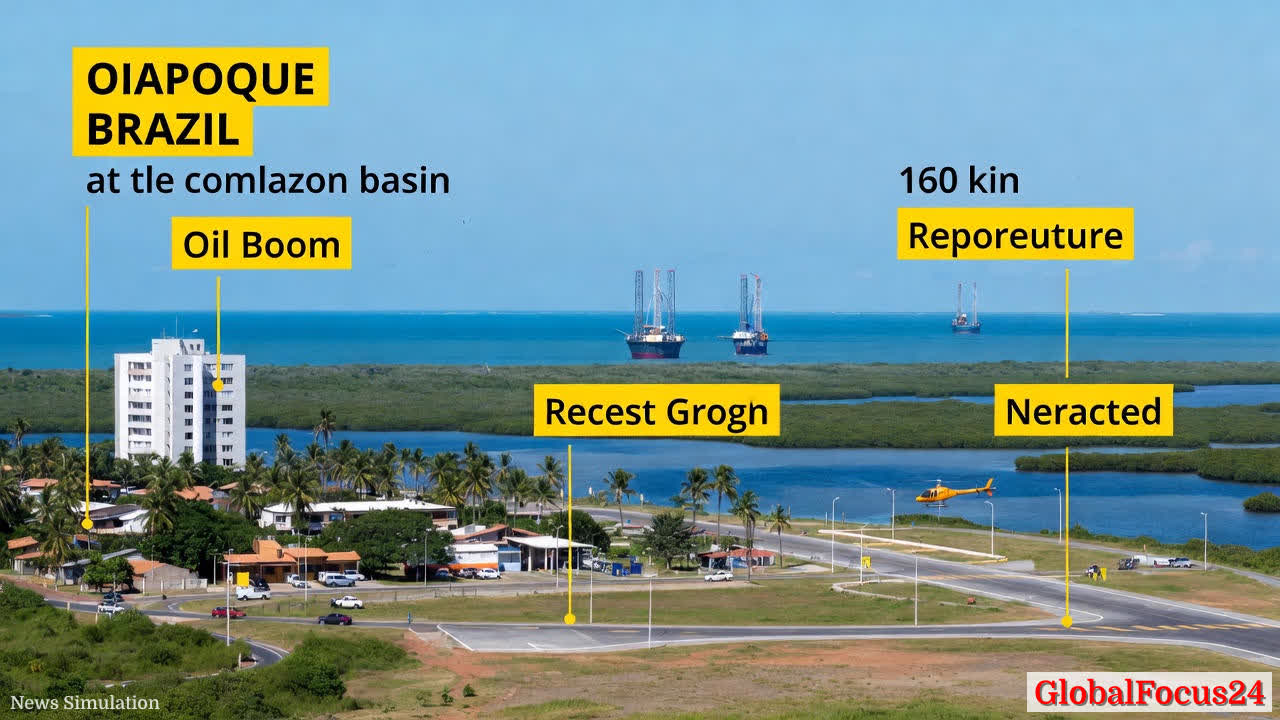
Oil Boom Transforms Brazil's Northern Frontier
Oiapoque: A frontier city on the cusp of an energy-driven transformation Oiapoque sits at the northern tip of Brazil, where the Amazon basin meets the Atlantic. It is a place where riverine livelihoods have long shaped daily life: fishermen weigh their catches at dawn, indigenous communities barter manioc and palm oil, and small streams of commerce thread through a landscape of dense mangroves and tidal flats. In recent years, however, the town has begun to resemble a staging ground for a larger economic drama that could reshape the North and redefine Brazil’s role in global energy markets. Signs of change are visible along the main street: new hotels sprout beside long-standing hillside taverns, a seven-story hotel is planned to open next year, and the local airport has undergone renovations to handle higher traffic. Helicopter rotors have become a familiar soundtrack—emblematic of a region braced for rapid change.
Historical context: Brazil’s search for new energy frontiers Brazil’s energy strategy has long balanced a mix of domestic demand, regional geopolitics, and environmental stewardship. The discovery and development of oil in the deep-water pre-salt reserves off the coast of Rio de Janeiro transformed the country’s economy in the 2000s and 2010s, turning Brazil into a major energy player in the Western Hemisphere. Yet those fields, while vast, face geological and operational limits, and production is projected to plateau and eventually decline after 2030. That prospect has pushed policymakers to seek diversification of supply sources and new corridors for growth. The Equatorial Margin, a prospective offshore belt extending along the northern Brazilian littoral and toward the Guyana-Suriname Basin, has emerged as a leading candidate to sustain Brazil’s oil output and stimulate regional development.
The discovery potential and regional parallels The October license granting Petrobras, Brazil’s state-controlled oil company, permission to explore roughly 160 kilometers off the coast marks a strategic moment. Industry assessments suggest the Equatorial Margin could hold tens of billions of barrels of oil in place, with a portion deemed recoverable under modern drilling techniques. The logic mirrors neighboring successes: Guyana has drawn global attention since major offshore discoveries surpassed billions of barrels, catalyzing a rapid expansion of GDP, jobs, and public expectations. Suriname’s similar offshore discoveries have reinforced the view that the Caribbean-Central Atlantic margin can host high-value resources in the near term. If Brazil can translate the margin’s potential into sustained production, the impact would extend well beyond extraction—affecting regional energy security, public budgets, and the balance of trade.
Economic impact: investments, jobs, and revenue mechanisms Brazil’s energy ministry projects substantial economic benefits if exploration and subsequent development proceed as envisioned. Investments could reach up to 280 billion reais, equivalent to about $52 billion, with a potential to create up to 350,000 jobs across construction, operations, and ancillary services. The public’s sentiment has shifted in favor of drilling: surveys show support rising to 42% from 26% in October, while a minority—about 49%—remains opposed. This mirrors broader public expectations that derive from potential improvements in local infrastructure, public revenue, and employment opportunities.
A sovereign wealth fund, inspired by Norway’s model, is among the policy instruments lawmakers are considering to translate oil wealth into lasting public benefits. The plan envisions channeling a portion of revenue into a fund designed to stabilize the economy during price fluctuations, invest in education and healthcare, and seed a transition toward a lower-carbon energy mix. The government also outlined a roadmap to reduce fossil fuel dependency, signaling an explicit intent to balance resource extraction with a long-term strategic shift toward renewables and energy efficiency. In a country where energy policy intersects with regional development and social equity, such a fund could provide a stabilizing framework for municipalities like Oiapoque that face a mix of rapid growth pressures and service-delivery challenges.
Policy context: balancing growth with environmental and social considerations Developments in the Equatorial Margin are unfolding against a backdrop of strong environmental awareness and a history of biodiversity stewardship. The region hosts vast mangrove ecosystems, a diversity of fish species, and marine mammals such as pink river dolphins and manatees. A deep-water reef, spanning roughly 1,000 kilometers, underscores both ecological richness and the risks associated with offshore exploration. The Amazon’s riverine currents can be powerful and unpredictable, with the Amazon contributing a significant share of the world’s freshwater to the oceans. These natural features heighten the importance of robust environmental safeguards, emergency response capabilities, and community involvement in decision-making processes.
Indigenous communities and local stakeholders have voiced concerns about the potential for ecological disruption and social displacement that often accompanies rapid resource development. While regulators and Petrobras emphasize safety protocols and risk mitigation, consultations with affected communities have highlighted the need for transparent, culturally aware engagement, fair compensation mechanisms, and ongoing monitoring to preserve the integrity of traditional livelihoods.
Regional comparisons: lessons from neighboring markets The Brazilian push into the Equatorial Margin stands in contrast with earlier development models in other parts of Latin America and beyond. In Guyana, discoveries have translated into a rapid expansion of GDP, job creation, and rising living standards, but also into concerns about governance, revenue management, and environmental protection. Suriname’s offshore activity offers another reference point, illustrating how resource extraction can unlock growth opportunities while requiring careful regulatory design and local capacity-building efforts. Brazil’s approach seeks to combine the best practices from these neighbors with a strong emphasis on regional infrastructure, social programs, and a sovereign wealth strategy designed to cushion volatility and fund a longer-term energy transition.
Environmental risk management and spill prevention The offshore environment in Oiapoque’s vicinity demands meticulous risk management. The convergence of deep-water drilling, strong Atlantic currents, and the Amazon’s influence on coastal dynamics creates a complex hydrodynamic setting. The risk of petroleum spills, though mitigated by advanced technology and robust safety protocols, remains a central concern for environmental groups, indigenous leaders, and local residents. Industry players argue that lessons from global offshore operations—such as double-hulled vessels, remote sensing, rapid containment, and dedicated response teams—will be integrated into Brazil’s regulatory framework. Nonetheless, ongoing independent monitoring, community-based environmental oversight, and transparent reporting will be vital to maintaining public trust and ensuring that development does not come at the expense of ecological integrity.
Infrastructural and public-service considerations Rapid investment will necessitate upgrades to roads, ports, healthcare facilities, schools, and housing. Oiapoque’s transformation hinges not only on energy development itself but also on the capacity of municipal and federal agencies to absorb influxes of workers, manage environmental impacts, and deliver essential services. Authorities have signaled intent to deploy a coordinated plan that addresses urban planning, housing affordability, waste management, and water security. If the proposed sovereign wealth fund materializes, part of its mandate could be to finance social infrastructure that benefits both long-standing residents and new arrivals linked to the oil industry.
Public reception and social dynamics Public sentiment in Oiapoque is a blend of optimism and caution. For some residents, the prospect of jobs and improved public amenities represents a pathway out of poverty and a chance to invest in children’s education and health. Others worry about price volatility, wage inflation that could outpace local incomes, and the possibility that a temporary boom could produce lasting inequalities. The bumper stickers in Amapá state—“Yes to development! Yes to petrol!”—reflect a pragmatic popular mood: support for development is tempered by a desire for assurances that the benefits will be broadly shared and that the natural environment will not be sacrificed for short-term gains.
Operational considerations: international partnership and local capacity Petrobras is expected to lead the exploration program, leveraging its deep-water expertise. International firms with exploration rights secured earlier this year will participate, bringing specialized knowledge, technologies, and capital. The collaboration has the potential to accelerate discovery and reduce technical risk, but it also introduces complexities related to governance, technology transfer, and local job training. Building domestic capacity—through training programs, universities, and vocational institutes—will be essential to ensure that a significant share of the employment benefits accrues to Brazilian workers and communities.
Environmental safeguards and community engagement Engagement with indigenous groups and local communities remains a non-negotiable component of development. Transparent negotiations, culturally sensitive consultation processes, and ongoing impact assessments should be standard practice. The aim is to establish a framework where development respects traditional rights, mitigates ecological harm, and provides channels for grievance redress. By embedding community participation in project design and monitoring, the likelihood of conflicts can be reduced, and trust can be fostered as operations scale up.
Long-term outlook: energy transition alongside oil extraction Brazil’s roadmap to reduce fossil fuel dependency signals an acknowledgement that oil wealth must be complemented by a robust transition to renewable energy. Investments in wind, solar, and bioenergy, alongside improvements in energy efficiency and grid modernization, are integral to sustaining growth beyond the life cycle of offshore fields. The northern margin offers a dual opportunity: it can bolster Brazil’s energy security and serve as a catalyst for green growth through revenue recycling, infrastructure investment, and technological innovation. The eventual decline of legacy deep-water production will require a managed phase-out and a strategic shift toward low-carbon industries that can absorb displaced workers and foster new economic sectors.
Daily life and culture at the edge of change For residents of Oiapoque, the oil project’s footprint will be measured not only in barrels but in the rhythms of daily life. River fish—the catfish, hake, and oscars that populate local waters—will continue to sustain many families, but the broader economic transformation could alter diets, consumer choices, and the fabric of the community. Entertainment, education, and healthcare are poised to improve if revenues are prudently managed and reinvested. The social contract between the state, industry, and local communities will define how the region negotiates development’s promises with its responsibilities to future generations.
The horizon: what success would look like A successful development pathway for the Equatorial Margin would combine several elements: robust production that stabilizes domestic energy supply and strengthens Brazil’s balance of payments; a transparent public finance framework that channels revenues into a sovereign wealth fund and targeted social programs; substantial investments in infrastructure and human capital; and a well-managed transition to renewables that protects biodiversity and respects indigenous rights. In this scenario, Oiapoque becomes a model of balanced growth, where energy wealth funds public goods, and local communities share in the prosperity generated by a modern, diversified economy.
Conclusion: a pivotal moment for Brazil’s northern frontier The offshore exploration in the Equatorial Margin represents more than a petroleum project. It is a test of Brazil’s capacity to alleviate regional disparities, manage environmental risk, and translate resource wealth into sustainable development. For Oiapoque and its surroundings, the coming years will reveal how a remote town navigates the pressures and opportunities of a new energy era. If managed with rigor, transparency, and a strong commitment to social and environmental safeguards, the oil boom could lay the foundation for a resilient economy that honors the region’s biodiversity, respects its cultural heritage, and positions Brazil as a responsible steward of its northern frontier.