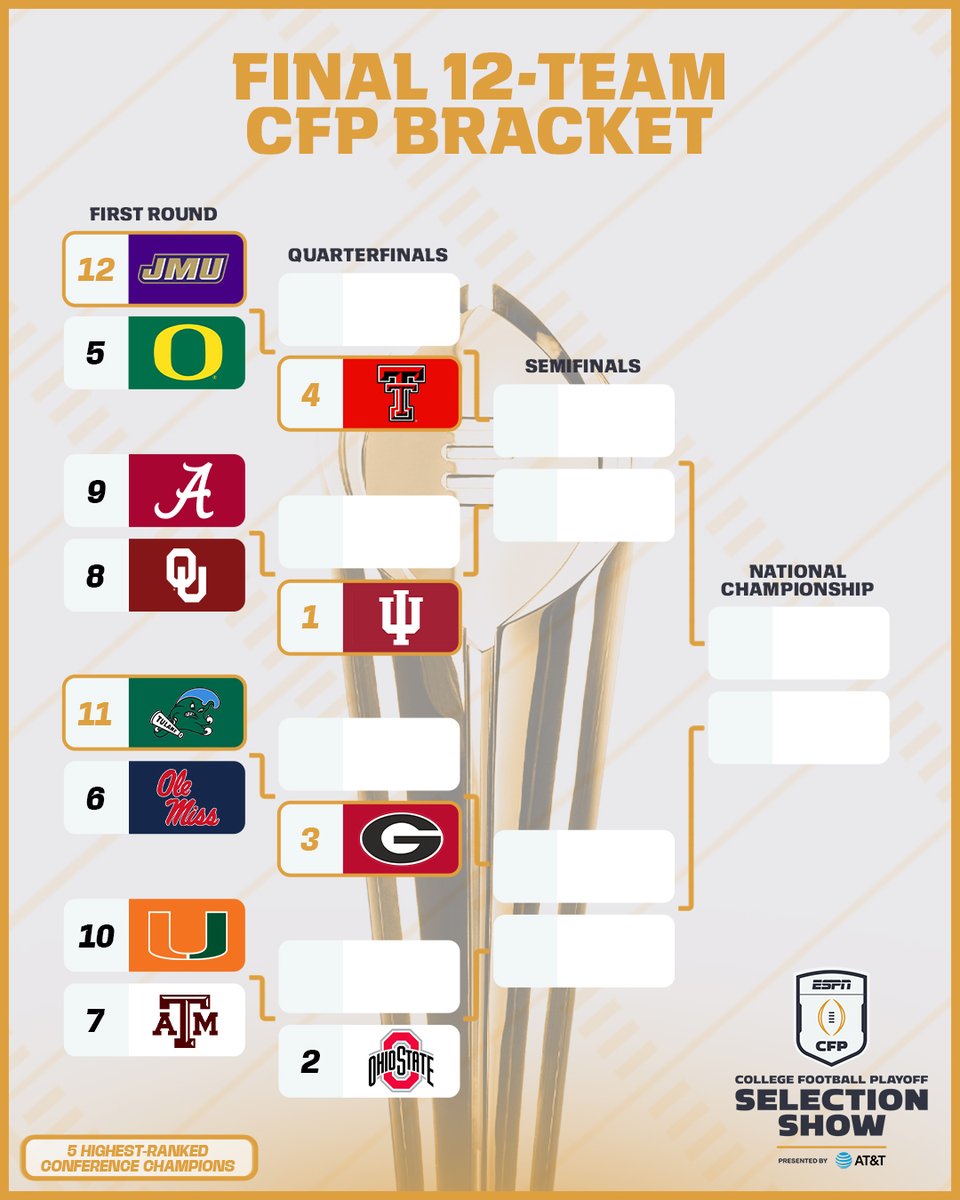
INDIANAPOLIS, December 7, 2025 — The College Football Playoff selection committee unveiled the official 12-team bracket for the 2025-26 season, marking a landmark expansion that integrates top conference champions with a broad slate of at-large contenders. Indiana University earned the No. 1 overall seed and a first-round bye, setting the stage for a high-stakes quarterfinals run that could redefine the program’s trajectory in the era of a 12-team field.
Historical context and evolution of the format The 12-team expansion represents a major shift from the traditional four-team playoff structure that had governed the College Football Playoff since its inception in 2014. Proponents argued that the broader field would better reflect the complexity of a long, multi-conference season, reduce the controversy surrounding at-large selections, and reward the discipline and depth required by modern power leagues. Critics, meanwhile, cautioned about potential scheduling pressures, player welfare concerns, and the challenge of maintaining a clear, playoff-centered national narrative in a crowded sports calendar.
Historically, major college football has wrestled with balancing conference pride, bowl game heritage, and the practical realities of a national championship selector. The 12-team bracket builds on a growing trend toward inclusivity without sacrificing the prestige of the semifinals and final, which retain the high-stakes, marquee atmosphere that has defined the sport for decades. This iteration guarantees representation for the five top conference champions and seven at-large berths, a configuration that accommodates both traditional powerhouses and rising programs with strong résumés during the regular season.
Indiana’s ascent and implications for the Big Ten Indiana’s ascent to the No. 1 seed stands as a milestone for a program that has historically balanced competitive success with the need to build depth across a demanding schedule. A dominant regular season, characterized by a blend of explosive offense, disciplined defense, and steady coaching, propelled Indiana to the top seed. The Hoosiers’ quarterfinal matchup against the winner of No. 8 Oklahoma and No. 9 Alabama presents a tantalizing test: a chance to demonstrate early-season form against storied programs with championship pedigrees.
Beyond Indiana, the bracket underscores the Big Ten’s continued strength in the playoff conversation. With Indiana securing the top seed, the conference showcases its ability to produce a program capable of sustaining excellence throughout a prolonged campaign, while also highlighting the breadth of competition within the league. The regional implications extend to media markets, recruiting dynamics, and fan engagement across the Midwest and beyond, where college football remains a central cultural touchstone.
Quarterfinals, semifinals, and the road to the national championship The quarterfinal pairings place significant emphasis on travel logistics and the distribution of power across the bracket. The Fiesta Bowl in Glendale hosts the Texas Tech vs. Oregon or James Madison winner, a clash that blends traditional strength with a Group of Five representation in James Madison. The Peach Bowl in Atlanta features Indiana against the Oklahoma/Alabama winner, a matchup that brings together a midwestern powerhouse and a pair of SEC contenders with national pedigree.
In the Rose Bowl, Ohio State faces the winner of Texas A&M or Miami, a potential cross-regional showdown that could redefine narratives around the Big Ten’s continued superiority in playoff contexts. The Sugar Bowl in New Orleans pairs Georgia against Ole Miss or Tulane, a contest that pits the defending SEC champion against a Tulane program riding momentum from the Group of Five representation.
The semifinals are scheduled for January 9-10, with the Orange Bowl in Miami and the Cotton Bowl in Dallas serving as the national semifinal sites. The national championship is slated for January 19 at Mercedes-Benz Stadium in Atlanta. These arrangements keep a premium on tradition—iconic venues, storied programs, and the electric atmosphere that accompanies major postseason games—while expanding the field to reflect contemporary college football realities.
Regional comparisons and potential regional revenue impact The 12-team format introduces new competitive dynamics across conferences and regions. In the Midwest, Indiana’s No. 1 seed could serve as a catalyst for regional optimism, potentially boosting ticket sales, local sponsorship, and alumni engagement as fans rally behind a program’s pursuit of a national title in a wider playoff context. The Southeast, represented by teams like Georgia, Ole Miss, and Ole Miss, remains a revenue powerhouse, with playoff games likely driving ancillary tourism, hotel occupancy, and local broadcasting rights value.
Another notable regional comparison lies in the West, where Texas Tech’s and Oregon’s appearances in the quarterfinals could generate cross-country interest and broaden the geographic footprint of playoff viewing. The representation of Tulane as a Group of Five contender signals a broader narrative—competitive balance and the potential for underdog stories to resonate with national audiences.
Notable exclusions and their implications The bracket’s field excludes some prominent programs, a reminder of the evolving balance between historical prestige and current-season performance. Undefeated Notre Dame did not earn a playoff berth, a decision that will spark ongoing discussions about strength of schedule, conference alignment, and the weighting of independent status in a multi-mate postseason. BYU, the Big 12 champion, did not secure a spot after a conference title loss, illustrating how the expanded field still depends on timely performance across key moments. ACC champion Duke’s omission adds another layer of debate about conference depth and the metrics used by the selection committee.
Economic and fan engagement impacts The expanded playoff format is expected to have far-reaching economic effects, from ticket sales and broadcasting rights to sponsorship activations and tourism. By extending participation to more teams, the playoff can amplify regional interest and create longer windows for advertisers to capitalize on marquee games. The increased number of high-stakes matchups could also boost streaming subscriptions, digital engagement, and social media conversation, contributing to a broader, more global audience.
Public reaction to the bracket has been mixed, with many fans praising the opportunity for more teams to compete on a national stage, while others express concern about the intensified schedule and the potential for player fatigue. Athletes, coaches, and administrators are closely watching how the expanded format will influence practice cycles, academics, and long-term health—topics that have become central to ongoing conversations about college sports governance and athlete welfare.
Team-by-team perspectives and potential storylines
- Indiana (No. 1 seed): A program on the ascent, now tasked with navigating a three-game stretch away from a national championship, beginning with a quarterfinal against either Oklahoma or Alabama. The storyline centers on building a sustained, championship-caliber culture and translating regular-season dominance into postseason success.
- Ohio State (No. 2) and Georgia (No. 3): Traditional powerhouses with proven track records in national contention. Their paths will likely include tests against high-caliber opponents, reinforcing the perennial argument that depth and experience matter in late-season play.
- Texas Tech (No. 4) and Oregon (No. 5): Programs that have shown explosive capabilities and strategic differentiation. How they manage travel, injury risk, and game preparation will be crucial in preserving playoff viability.
- Oklahoma (No. 8) and Alabama (No. 9): A storied rivalry with high stakes in the first round, illustrating how conference heritage and individual program resilience manifest in the expanded format.
- Tulane (No. 11) and James Madison (No. 12): Group of Five representatives that underscore the integrity of the bracket’s inclusive design. Their presence invites broader regional narratives and potential breakthrough performances.
Football culture and the broader sports landscape The 2025-26 playoff alignment reflects broader shifts in American sports toward expanded postseason opportunities and greater parity. The bracket demonstrates the sport’s willingness to adapt to a long, multi-month season by offering multiple high-stakes opportunities for teams to prove their merit. The resulting fan energy, campus celebrations, and media coverage are likely to reinforce college football’s status as a central cultural phenomenon in the United States, with ripple effects in youth participation, collegiate branding, and regional pride.
What comes next for fans, programs, and markets As teams prepare for the first-round games on December 19 and 20, anticipation will intensify around coaching decisions, injury updates, and strategic game plans designed to maximize performance in this new playoff era. For fans, the bracket provides a roadmap of potential cross-conference clashes, historic rivalries renewed on a national stage, and the possibility of underdog stories capturing the public imagination.
For programs, the emphasis will be on depth management, rest versus rotation strategies, and maintaining academic balance amid a compressed postseason schedule. Market analysts will scrutinize attendance figures, broadcast ratings, and sponsorship activations as indicators of the playoff’s financial vitality and its impact on the broader college football ecosystem.
In sum, the 2025-26 College Football Playoff bracket signals a defining moment for the sport: a broader, more inclusive platform for the best teams to compete for a national title, while preserving the tradition, rivalry, and dramatic storytelling that have long defined college football. The road ahead promises not only elite football but a dynamic, evolving conversation about how best to celebrate, commercialize, and conserve the spirit of the college game in a rapidly changing landscape.